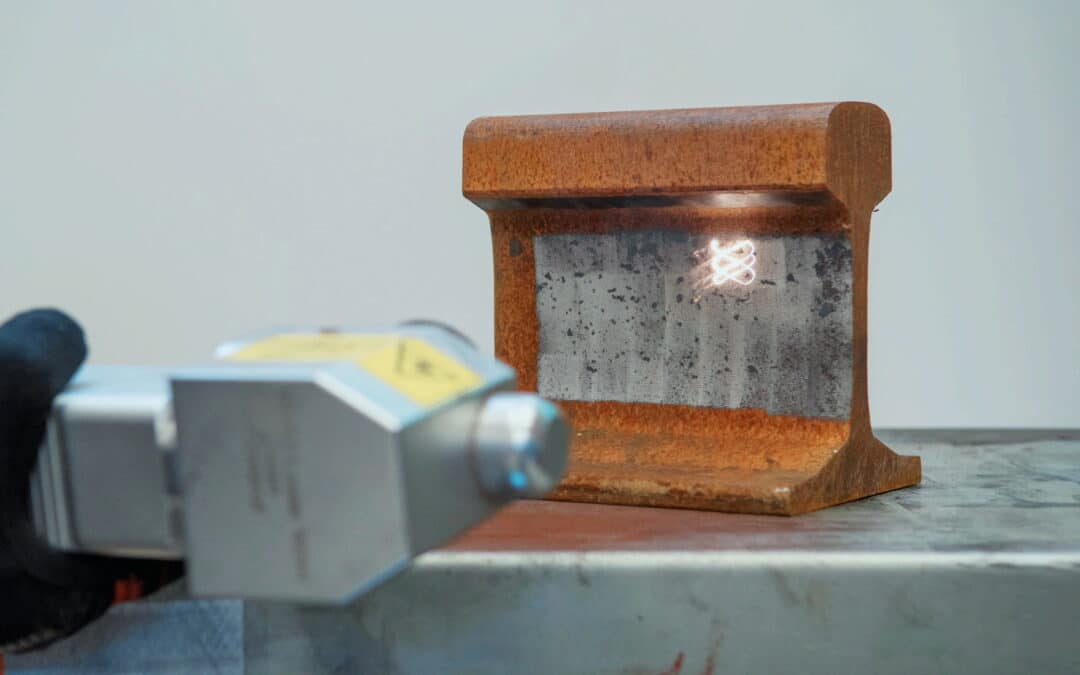
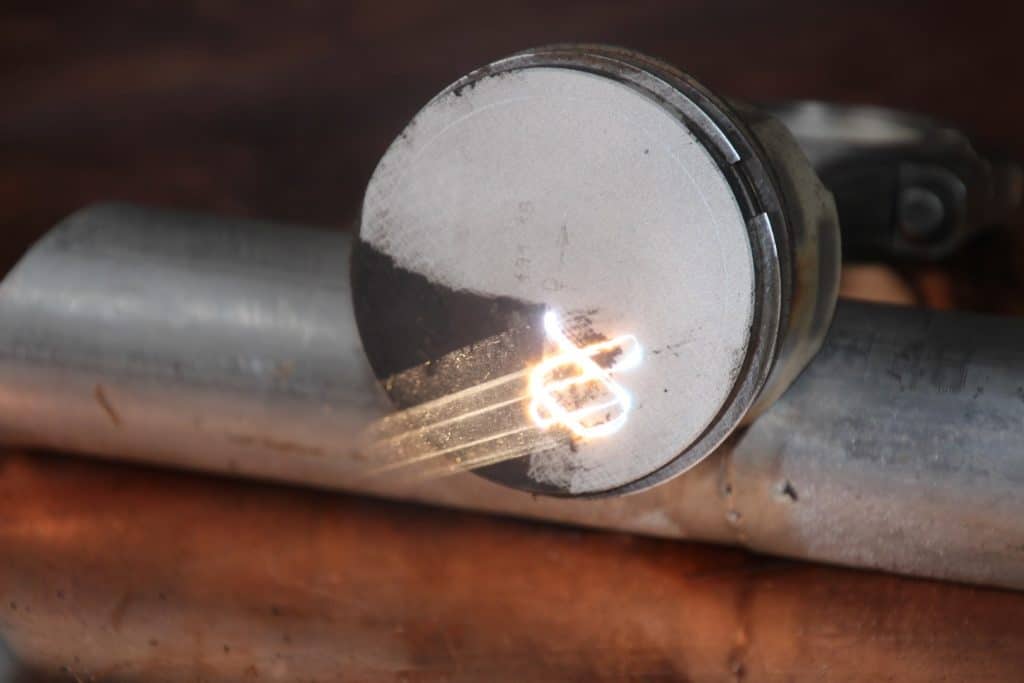
Laser oxide removal means lifting the oxide layer that forms on a metal surface, such as mill scale, oxidation, or weld heat tint, using a laser beam, without acids, sand, or mechanical grinding. When steel has been hot-rolled or left exposed to air, a layer forms on its surface that prevents paint, coating, or weld from bonding properly. This layer has to come off before the next production step, and traditional methods, such as acid pickling or sandblasting, bring wastewater, chemicals, and dust along with them. Laser lifts off the same layer contact-free and leaves behind a clean surface that’s ready for coating.
In this article, we go through what mill scale is, why oxidation interferes with coating and welding, how laser oxide removal compares to chemical pickling, and what kind of surface the laser leaves behind for painting or coating.
W2M Industries Oy is a Finnish company founded in 2017. Our products are made in Finland, and every delivery includes operational training and orientation. Read more about laser cleaning if the technology is new to you.
What is mill scale?
Mill scale is the iron oxide layer that forms on steel during hot rolling. When steel is heated above 570°C during rolling, a layered oxide forms on the iron’s surface, made up mainly of wüstite, magnetite, and hematite. The scale is firmly attached but electrochemically more noble than the steel underneath. This is why mill scale has to be removed before painting or coating.
Mill scale typically appears on hot-rolled steel as a bluish-grey, slightly shiny layer. It isn’t just surface dirt, but a chemically bonded oxide layer usually a few tens of micrometres thick. The problem is that scale eventually flakes off on its own, and if paint has been applied over it, the paint comes off along with the scale. On top of that, the scale forms a galvanic couple with the steel, which accelerates corrosion right where the scale has already partly broken away.
Removing mill scale is therefore a basic task in industrial surface treatment. Surface preparation requirements are defined in the standard SFS-EN ISO 8501-1 (Finnish standards store, in Finnish), which describes rust grades and preparation grades for steel surfaces (for example, Sa blast-cleaning grades). The standard doesn’t take a position on which method is used to clean the surface, only on how clean the result needs to be before coating. Laser cleaning is one way to reach the required cleanliness level, alongside sandblasting and pickling.
How oxidation forms and why it’s a problem
Oxidation forms whenever a metal is exposed to oxygen. Mill scale forms in the heat of rolling, but an oxide layer also builds up at ordinary temperatures: structural steel picks up surface rust, stainless steel gets heat tint after welding, and aluminium develops a tight oxide film as soon as the bare surface is exposed. All of these are oxide, just in different forms and thicknesses, and all of them interfere with the next production step in the same way: they get in between the paint, coating, or weld and the clean base metal.
Oxidation causes problems in three areas. First, adhesion: paint and coating bond to clean metal, not to oxide, so if scale or oxidation is left under a coating, the coating eventually comes off along with the oxide layer, and that’s a sign of inadequate surface preparation rather than a quality issue with the coating itself. Second, corrosion: many oxides form a galvanic couple with the base metal, which speeds up rusting at the points where the scale has already broken. Third, weld quality: an oxide and contamination layer in the joint causes porosity and lack-of-fusion defects, so a weld seam needs to be cleaned both before and after welding.
Heat tint from welding stainless steel deserves its own mention. The bluish or yellowish area left next to a weld is a thin oxide layer that weakens the stainless steel’s corrosion resistance right at the spot that was heated, and this layer has to be removed so the passive layer can reform. Laser oxide removal is particularly well suited to this, because power and pulse can be adjusted so that the thin heat tint lifts off without damaging the stainless steel itself. The same machine handles both pre-weld and post-weld treatment of the seam, which we cover in more detail in the article on laser cleaning before welding.
How much oxidation there is, and what kind, varies by target, and this is exactly what determines how the cleaning should be done. Thin surface rust or fine heat tint lifts off with light settings, while thick, flaking mill scale needs more energy or several passes. The base metal matters too: steel, stainless steel, and aluminium all react to the laser differently. This is why knowing the target matters more than the machine’s wattage alone.
Laser vs. pickling
Oxide and mill scale can be removed in several ways. The most common options are laser cleaning, chemical pickling, and mechanical cleaning (sandblasting or grinding). The decisive difference in industrial surface treatment is what the method leaves behind: laser produces no acids and no wastewater, while pickling relies on acids and their controlled handling. Below is a comparison of three methods. The comparison gives a general picture, since exact figures depend on the target and the required cleanliness level.
| Comparison point | Laser cleaning | Chemical pickling | Mechanical (sandblasting / grinding) |
|---|---|---|---|
| Chemicals | No chemicals | Acids (e.g. nitric and hydrofluoric acid) | No chemicals, but grit/dust |
| Wastewater and waste | No wastewater, little solid dust | Acidic wastewater and neutralization | Sand and oxide dust, spent grit |
| Surface precision | High, targetable strip by strip | Whole dipped/treated area | Coarse, whole surface at once |
| Base material | Preserved, no mechanical wear | Can corrode, requires rinsing | Can roughen and thin the surface |
| Follow-up work | No rinsing, surface often ready for coating right away | Rinsing, neutralization, drying | Dust and grit removal, drying |
| Environment and permits | No chemical emissions, no water | Chemical safety and permits (Tukes) | Dusty, local extraction needed |
| Best suited for | Precise, localized work, sensitive surfaces | Large batches, complex shapes by dipping | Large, rough surfaces |
Laser oxide removal is contact-free, chemical-free, and free of consumables. This is exactly what sets it apart from chemical pickling, where acids, rinsing, and wastewater treatment are all part of the process.
Pickling’s strength is handling large, geometrically complex parts by dipping: the whole part gets cleaned at once, including internal surfaces and cavities that are hard to reach with a laser or blasting grit. This is a genuine advantage for some targets, and laser doesn’t replace pickling everywhere. Pickling’s downside, however, is managing the chemicals involved. Acid pickling uses strong acids that require proper protective equipment, ventilation, and wastewater treatment, and guidance on this is available from Finland’s Occupational Safety and Health Administration and, for chemical safety, from Tukes (both in Finnish). The spent acid and rinse water count as hazardous waste, and their neutralization and disposal come with their own cost and permit requirements.
This is exactly where laser cleaning’s strength lies: the process produces no acidic wastewater and no chemical waste, and the oxide that lifts off the surface is captured as a solid particle with local extraction instead of being dissolved. The method is also localized and precise, so you can clean just the area next to a weld seam or the surface of a single sheet without touching the rest of the part. That makes laser especially well suited to targets where the part can’t or shouldn’t be dipped in an acid bath, where you want to avoid handling chemicals altogether, or where the base material’s thickness and shape need to be preserved precisely.
It’s worth looking at total cost beyond the single work step. With pickling, the acids and rinse water are a recurring purchase and a recurring waste stream, and wastewater treatment is an ongoing cost, whereas with sandblasting, the grit wears down and the resulting dust has to be sorted out every time. A laser cleaning machine, by contrast, has no consumables at all: once the machine is bought or rented, cleaning another part adds no material cost and produces no new hazardous waste. Over the longer term, this changes the calculation especially in workshops where oxide and mill scale removal is a routine task.
A surface ready for coating
The goal of surface treatment isn’t just a clean surface, but one that the next step, whether paint, coating, or weld, will bond to reliably. This is where laser cleaning delivers two practical advantages: the surface is ready right away without rinsing or drying, and the cleanliness level is repeatable strip by strip.
Once the laser has lifted off the mill scale or oxidation, there’s no solvent residue, acid, or sand left on the surface, so it doesn’t need to be rinsed and dried before coating the way it would after pickling. Paint or coating adhesion depends on two things, surface cleanliness and its profile, meaning roughness, and with laser both can be controlled by adjusting power, pulse type, and scan speed: a light setting leaves a smoother surface, while a stronger setting produces a slightly rougher profile, which can improve adhesion for some coatings. The exact settings depend on the coating system and the target, though, so it’s worth asking for an assessment based on the specific target and coating requirement.
Repeatability matters for coating just as much as cleanliness does. Because the laser’s settings, such as power, speed, and pulse, are numbers, the same cleaning result can be reproduced from one part to the next using the same values. This is an advantage especially when the coating requirement has to be documented or when the cleanliness level has to meet a standard. The surface preparation grade is assessed visually against the standard SFS-EN ISO 8501-1, and regardless of the method used, the goal is the same: oxide, scale, and contamination removed before coating.
It’s also worth remembering that a cleaned metal surface starts oxidizing again as soon as it’s exposed to air, and bare steel in particular rusts quickly in damp conditions. That’s why coating or painting should be done as soon as possible after cleaning, before new surface rust has a chance to form. The laser’s advantage here is that cleaning can be done right at the target, just before coating, without a separate acid bath or blasting cabinet. The work can be done by one person, quietly and dry.
As a method, laser oxide removal is contact-free and uses no liquids, gases, or consumables. It isn’t hot work the way welding is, it can be done by one person, and it’s quiet compared to sandblasting. The laser is, however, a high-energy, regulated technology, so the work is always done wearing laser safety glasses and a respirator and according to the work instructions. That’s why operational training and orientation are included with every W2M delivery.
Request a Quote or Rent a Machine for Testing
W2M Laser is a brand of W2M Industries Oy. Our products are made in Finland, and every delivery includes operational training, orientation, and a warranty: 24 months on W2MCF and W2MCW machines, 12 months on the mini cleaners. Mini laser cleaners start at €5,500 (VAT 0%); portable W2MCF models and heavy-duty W2MCW models are priced upward from there depending on power.
Not sure whether laser is right for your oxide or mill scale removal job? Rent the machine for a project and test it on your own target before deciding to buy. Rental includes product and safety training, which is free of charge with a weekly rental. Tell us what metal you’re working with, how thick the oxidation is, and what your coating requirement is, and we’ll recommend the right model and power range. You can also find out more about renting a machine.
Contact us: Juhani Tamminen (Entrepreneur | Laser Sales, Technical Expert), +358 40 709 4605, [email protected].
W2M Industries Oy, Koivulehdontie 2, 01510 Vantaa, Finland.
Frequently Asked Questions
What is laser oxide removal?
It means lifting the oxide layer that forms on a metal surface, such as mill scale, oxidation, or weld heat tint, using short laser pulses. The method is contact-free, uses no chemicals, and leaves no wastewater, and it leaves behind a clean base metal ready for coating or welding.
What is mill scale, and why does it need to be removed?
Mill scale is the iron oxide layer that forms on steel during hot rolling. It has to be removed because paint and coating bond to clean metal, not to oxide. On top of that, scale eventually flakes off on its own and forms a galvanic couple with the steel that speeds up corrosion.
How does laser oxide removal differ from chemical pickling?
Pickling relies on acids that dissolve the oxide; it requires rinsing, neutralization, and wastewater treatment. Laser lifts off the same layer contact-free, without acids or wastewater, capturing it as a solid particle with local extraction. Pickling suits dipping large batches, while laser suits precise, localized cleaning.
Does laser damage the base metal when removing oxide?
No, when the laser is properly adjusted. Oxide and clean metal react to the laser differently, so a well-set laser lifts off the oxidation while preserving the base material. By adjusting power and pulse, even thin heat tint can be removed without damaging stainless steel or a thin sheet.
Is laser suitable for removing heat tint from welded stainless steel?
Yes. The blue or yellow heat tint left next to a weld is a thin oxide layer that weakens corrosion resistance. Laser removes it in an adjustable, controlled way that lets the passive layer reform. The same machine handles both pre-weld and post-weld treatment of the seam.
Is the surface ready for painting right after laser cleaning?
Usually, yes. Laser leaves no acid, solvent residue, or sand, so the surface doesn’t need to be rinsed and dried. That said, a cleaned metal surface does start oxidizing again once exposed to air, so coating or painting should be done as soon as possible after cleaning.
What metals is laser oxide and oxidation removal suitable for?
Laser suits steel, cast iron, stainless steel, and aluminium. It’s used to remove mill scale, surface rust, heat tint, and other oxides, as well as for surface preparation before welding, painting, or coating. Describe your target and we’ll assess whether it’s a good fit.
Should I buy my own machine or rent one for oxide removal?
If oxide and mill scale removal is an ongoing need, your own machine pays for itself, since there are no consumables involved. For a one-off or seasonal need, renting makes the most sense. We recommend renting the machine first and testing it on your own target before buying.