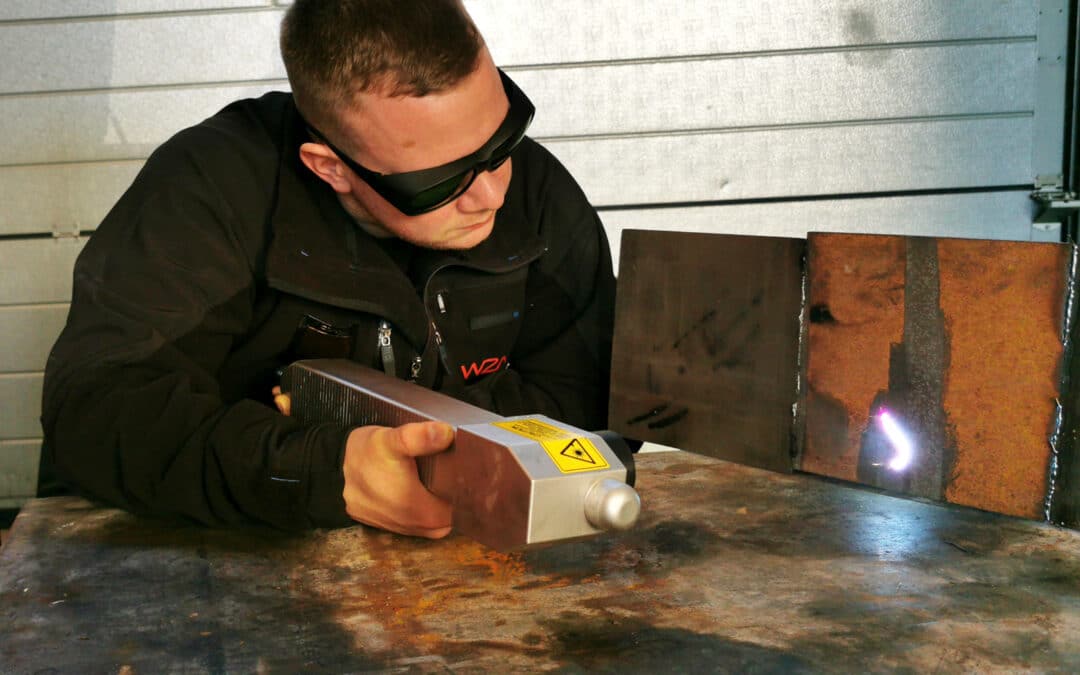
Laser cleaning and welding together solve one of the oldest problems in metal fabrication: a dirty seam doesn’t weld well. When a steel surface has rust, mill scale, oil, or old paint on it, these contaminants mix into the weld pool and leave behind porosity, cracks, and a weak joint. The traditional fix, an angle grinder, wire brush, or solvent, creates dust, wears away base material, and takes time. A laser removes the contamination without contact and leaves behind a clean surface that’s ready to weld.
In this article we’ll look at why a seam should be cleaned before welding, how laser cleaning compares to grinding and other preparation methods, how it removes oxide and oil, and how it shows up in weld quality. You’ll also get a practical picture of how this same work is done with W2M equipment.
W2M Industries Oy is a Finnish company founded in 2017. Products are manufactured in Finland, and every delivery includes operator training. Read more generally about laser cleaning.
Why a Seam Is Cleaned Before Welding
Cleaning a weld seam before welding is the foundation of quality assurance: a surface free of oxide, rust, oil, and paint is a prerequisite for a sound, durable joint. A dirty surface introduces hydrogen, oxygen, and other contaminants into the weld pool, which cause porosity and inclusions.
When welding over a dirty surface, contaminants end up in the weld pool and end up in the finished weld. Rust and mill scale contain oxygen, which forms oxides and gas bubbles in the melt. Oil, grease, and moisture introduce hydrogen, which causes hydrogen cracking, especially in higher-strength steels. Paint and coatings burn in the heat of the arc and produce both porosity and harmful fumes. The end result shows up in X-ray images and durability tests: porosity, inclusions, and a weakened joint.
Surface cleanliness can be defined and assessed. In practice, the requirement comes through the welding procedure specification: the more demanding the application, the more precisely the starting surface is defined. The more demanding the application, the higher the required cleanliness level, which further underscores the importance of preparation.
Groove preparation is key here. The weld groove, meaning the beveled joint area between the pieces being welded, is exactly the area where the weld pool penetrates deepest and where contaminants cause the most damage. When the groove surfaces and their surroundings are clean, the root pass succeeds and the whole joint holds. Laser cleaning reaches evenly into the bottom of the groove and the bevels, and unlike a grinding disc or sanding belt, it doesn’t round off the groove edges in the same way.
Laser vs. Grinding for Surface Preparation
A seam and groove can be cleaned in many ways. The most common methods are an angle grinder or disc, wire brush, sandblasting, and chemical solvent cleaning. Below is a comparison of how laser cleaning stacks up against these. The comparison is a general overview. Exact figures depend on the application, material, and thickness of the contamination.
| Comparison point | Laser cleaning | Angle grinder / disc | Wire brush | Sandblasting |
| Speed on a seam | Even, targeted | Fast on small areas, variable | Slow, laborious | Fast on large areas, setup takes time |
| Surface damage | No mechanical wear, base material preserved | Wears down and rounds off groove edges | Roughens surface, may leave bristle residue | Roughens surface, wears it down |
| Dust and noise | Quiet, loosened material goes to extraction | Loud noise, sparks, dust | Dust, moderate noise | Heavy dust and noise, requires enclosed space |
| Follow-up work | Minimal, surface often ready to weld immediately | Edge inspection, deburring | Checking for bristle residue | Cleanup of abrasive media, follow-up inspection |
| Consumables | No consumables | Discs and grinding wheels wear out | Brushes wear out | Sand/media is continuously consumed |
Laser cleaning is contact-free, chemical-free, and uses no consumables. This is exactly what sets it apart from grinding, wire brushing, and sandblasting: the base material isn’t worn down, the groove edges stay sharp, and the process leaves no abrasive grit or solvent residue on the seam surface.
The practical difference shows up best at the groove edges. An angle grinder is fast on small areas, but it wears away metal and easily rounds off the groove bevel, which changes the root-pass geometry. A wire brush is gentler but slow, and often leaves some oxide behind. A laser removes the surface layer evenly without wearing down the base material. The same device handles both light removal of heat tint and heavier scale removal, depending on how the settings are chosen for the application.
The decisive figure is the total cost of the process step. Grinding discs, wire brushes, and sand are recurring purchases, and the waste they produce has to be dealt with. A laser cleaner has no consumables at all: once the equipment is purchased or rented, each cleaned seam adds no material cost. Noise and dust are also significantly lower, which makes work easier in confined and indoor settings.
Removing Oxide and Oil
Before welding, two main groups of contaminants need to be removed from the seam: oxides (rust, mill scale, heat tint) and organic contamination (oil, grease, cutting fluid, moisture). Laser cleaning removes both with the same device, though by slightly different mechanisms.
Oxide removal relies on ablation: the short, powerful pulses of a fiber laser hit a thin surface layer, which heats up so quickly that the oxide detaches and vaporizes. Because rust, scale, and clean steel react differently to the laser, a well-tuned laser removes the contamination without damaging the metal underneath. Mill scale, the dense oxide layer formed during hot rolling, is a good example: it’s especially harmful in welding because it contains oxygen and comes off unevenly when ground. A laser removes scale evenly from the groove surface.
With oil and grease, the mechanism is somewhat different. A thin organic layer vaporizes and burns off from the laser’s energy, leaving the surface dry and clean without solvents. This is a significant advantage: traditionally an oily seam is wiped down with solvent, which dries slowly, leaves residue, and produces solvent fumes. With a laser, the same device that removes oxide handles this step too.
When paint, zinc coating, or oil vaporizes off a surface, fumes are produced, which should be captured with local exhaust ventilation and which require a respirator. Good information on the health effects of welding and cleaning fumes, and how to control them, can be found in guidance from the Finnish Institute of Occupational Health. Laser cleaning isn’t hot work, so it can be carried out by a single person. The method is also very quiet. However, a laser is a high-energy, regulated technology: the work is always done with safety glasses and a respirator, following the work instructions. That’s why operator training and orientation are included with every W2M device.
One practical rule is worth remembering: the thicker and denser the contamination, the more power or additional passes it requires. Light flash rust or heat tint comes off with light settings, while thick scale requires more energy. Exact power levels and scanning speeds depend on the device model and the application.
Improved Weld Quality
The benefit of surface preparation shows up directly in weld quality. When the groove and its surroundings have been laser-cleaned before welding, weld quality improves in several measurable ways.
Fewer pores and inclusions. Once oxygen-containing oxide and hydrogen-carrying oil have been removed from the surface, no gas or solid contaminants can get into the weld pool. This reduces porosity and inclusions, which are among the most common welding defects and show up on X-ray inspection.
Better penetration and root-pass quality. A clean, even groove lets the arc or laser beam penetrate in a controlled way. The root pass, the first pass welded into the root, succeeds better when there’s no scale at the bottom of the groove and the edge hasn’t been rounded off by grinding.
More consistent, repeatable results. Laser cleaning is a controlled, repeatable process: the same settings produce the same level of cleanliness from one workpiece to the next. This matters in series production and in procedure qualification testing, where the outcome needs to be documented.
Less post-processing. When preparation is clean, post-weld cleanup is lighter too. The same device serves both ends of the process: it’s suited to preparing surfaces before welding and to cleaning weld seams afterward. With stainless steel, post-cleaning is especially important, since the heat tint left by welding, an oxidized zone, weakens the surface’s corrosion resistance.
In welding procedure qualification and quality assurance, surface preparation is part of the accepted procedure. For example, laser welding procedure qualification is addressed in the standard SFS-EN ISO 15614-11.
Combined Cleaning and Welding with W2M Equipment
As a pair, laser cleaning and laser welding form a natural workflow in many industrial settings: first the groove is cleaned, then it’s welded, and often the seam is cleaned again afterward to remove heat tint. W2M’s advantage is that you get both machines, training, and service from the same company.
Cleaning side. All of W2M’s cleaning devices are fiber lasers; the difference lies in pulse mode and power class. The W2MCF line of portable fiber laser cleaners, with MOPA pulsing, is suited to seam and groove preparation requiring sensitive, precise work. For heavy-duty, large-surface work there’s the W2MCW line, which uses a continuous-wave (CW) beam. The lightest mini cleaners weigh only about 7 kg.
W2M was the first on the market to introduce mini laser cleaners, with prices starting from €5,500 (0% VAT). This moved seam cleaning into a portable, handheld class of equipment suited to both field work and the workshop.
Welding side. The handheld W2M-CW1000H (1 kW) and W2M-CW2000H (2 kW) laser welding machines weld all metals 2–10× faster than traditional arc welding. A combined workflow means the same operator can clean and weld using the same protective equipment, without a separate preparation station.
Not sure whether laser cleaning is right for preparing your seams? Rent a device for a project, test it on your own application, and decide afterward. Rental includes operator training and orientation. Read more: laser cleaning equipment rental.
Test Before You Buy
Laser cleaning and laser welding as a working pair is exactly the kind of setup best evaluated on your own application: your own steel, your own groove, your own rust. That’s why it’s worth testing before you buy.
Request a demo or rent a device. Describe what kind of metal you’re working with and how thick the oxide or oil is, and we’ll recommend the right model and pulse type. You’ll get full operator training and orientation, and you’ll test laser cleaning on your own seams. Renting is a practical first step before investing.
Request a quote or rent a device →
Frequently Asked Questions
Why does a weld seam need to be cleaned before welding?
A dirty surface introduces oxygen, hydrogen, and other contaminants into the weld pool, causing porosity, inclusions, and cracks. Rust and mill scale contain oxygen, oil and moisture bring hydrogen, and paint burns in the arc. A clean groove is a prerequisite for a sound, durable joint, and the cleanliness requirement is usually documented in the welding procedure specification.
How does the combination of laser cleaning and welding work?
The same operator cleans the groove with a laser cleaner and welds it with a laser welding machine, using the same protective equipment. Often the seam is also cleaned after welding to remove heat tint. W2M supplies both machines, training, and service under one roof, so the whole chain is controlled and documented.
Does laser cleaning damage the groove edges or base metal?
No, provided the fiber laser is correctly tuned. Unlike an angle grinder, a laser doesn’t mechanically wear away metal or round off the groove bevel. Oxide and clean steel react differently to the laser, so a well-set laser removes the contamination while leaving the base material and groove geometry intact.
Does the laser remove both oxide and oil with the same device?
Yes. Oxides, rust, and mill scale are removed by ablation, and a thin layer of oil or grease vaporizes from the laser’s energy. The same device handles both without a separate solvent wash, so groove preparation happens in one process step instead of two.
Is laser cleaning safe before welding?
The method is contact-free, uses no chemicals, isn’t hot work, and can be done by one person. However, a laser is high-energy, so the work is always done with laser safety glasses and a respirator. Vaporized material should be captured with local exhaust ventilation. Operator training and orientation are included with every W2M delivery.
What materials is laser cleaning of seams suitable for?
Laser cleaning is suitable for steel, stainless steel, and cast iron, among others. It’s used to remove rust, mill scale, oxide, heat tint, and oil before welding, as well as heat tint after welding. Describe the material and contamination, and we’ll assess suitability and the right pulse type.
How fast is laser groove preparation?
Speed depends on the thickness of the contamination, the device’s power, and the application, so no single figure can be given. The advantage stands out most on groove bevels and uneven surfaces, where grinding would be slower and would wear down base material.
Is it worth buying your own device for seam cleaning, or renting one?
If preparation work is ongoing, owning a device pays for itself, since there are no consumables. For a one-off or seasonal need, renting can be the more sensible choice.