Laser cleaning and sandblasting are two ways to remove rust, paint and oxide from metal. Both work. The difference lies in the surface that is left, how much dust and waste are produced and how long the whole job takes.
We compare how the methods work, their effect on the base material, dust and waste, and cost. At the end, we explain when sandblasting is still the more sensible choice. Our range is presented on the laser cleaning page.
W2M Industries Oy is a Finnish company founded in 2017. The products are made in Finland, and every delivery includes operator training.
Two surface treatment methods
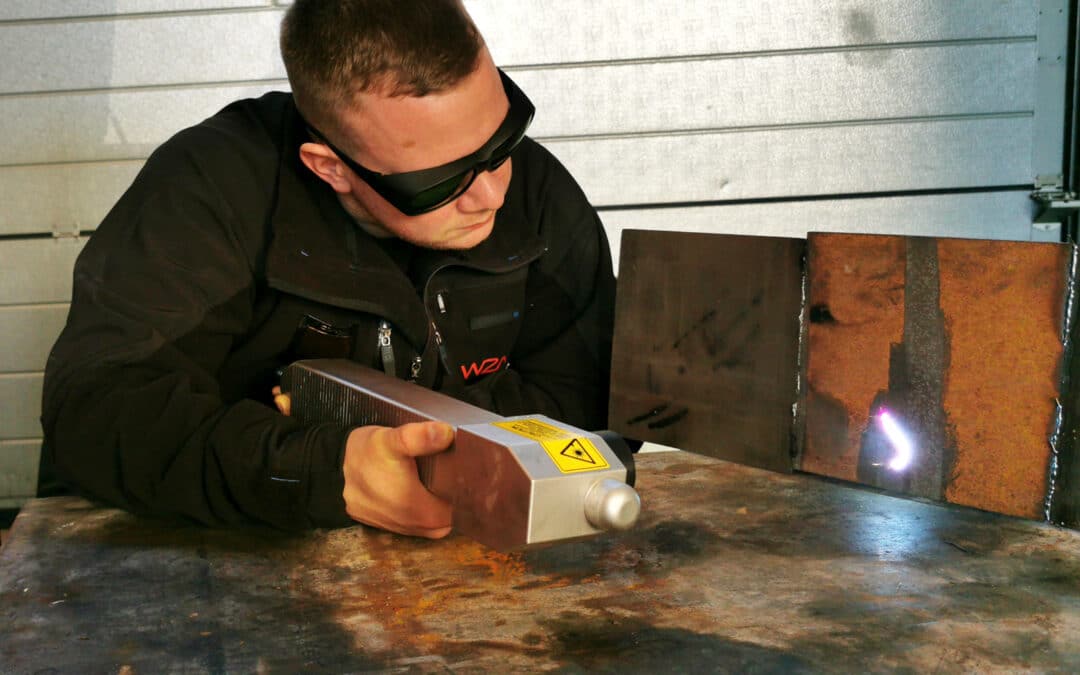
Laser cleaning is a non-contact method in which short laser pulses vaporize the layer of dirt or oxide or break it loose as fine dust. In sandblasting, compressed air blows blasting media from a nozzle onto the surface, and the media abrades the contaminant away. Laser cleaning requires neither sand nor chemicals.
Both methods remove rust, old paint, mill scale and oxidation. The choice therefore depends on the object, the work environment and what happens to the surface afterward.
The difference in operating principle
Sandblasting is a mechanical method. The stream of blasting media abrades the surface until the contaminant is gone, and in doing so also wears away a little of the base material. The article Laser Mold Cleaning describes this from the molds’ point of view: the blast stream removes a thin layer of mold steel, rounds off sharp details and changes the surface roughness.
A laser works differently. The layer being cleaned absorbs the laser’s energy and comes off, but the base material reflects laser light differently from dirt or rust. With the right settings, the base material stays unchanged. The user selects the cleaning pattern, power and speed from the machine’s menu according to the material and how dirty it is.
In practice, the rust turns into dust under the beam, and a clean metal surface is left. The vaporized dirt is collected with local exhaust ventilation. In sandblasting, by contrast, the blasting media and dust spread around the work site.
What the surface is like afterward
If a part is painted or coated, the cleanliness and roughness of the surface determine how well the coating adheres. Sandblasting roughens the surface, and the dust and blasting media must be removed before coating. After laser cleaning, no sand, acid or solvent residue is left on the surface. Because the method uses no liquids, the surface does not need to be rinsed or dried.
The final surface quality depends on, among other things, the machine, the settings and the application. It is therefore worth verifying with a test piece that the surface meets the requirements of the coating.
What happens to the surface next
It is best to choose the method according to what is done to the surface after cleaning. A seam to be welded, a beam to be painted and a plate to be coated place different requirements on the surface.
Welding. In welding, the cleanliness of the groove is decisive. Rust and mill scale bring oxygen into the molten weld pool, and oil and moisture bring hydrogen. These cause porosity and inclusions in the weld. Sandblasting roughens the surface of the groove, and the blasting media must be cleaned out before welding. The laser removes the mill scale from the bottom and bevels of the groove without rounding the edges, so the groove keeps its designed shape. After welding, the same machine can remove heat tint from stainless steel. The work steps are covered in more detail in the article Laser Cleaning Before Welding.
Painting and coating. The required cleanliness can be agreed with the client or the painter using the standard SFS-EN ISO 8501-1:2007. The standard describes the rust grades of steel surfaces and the preparation grades for blast cleaning, hand-tool cleaning and flame cleaning, for example the Sa blast cleaning grades. The standard does not mention laser cleaning, so the cleanliness aimed for with a laser and how it is verified should be agreed in advance. Laser settings such as power, speed and cleaning pattern can be recorded if compliance with the coating requirement must be documented.
Timing also matters, because cleaned steel can rust again quickly. With a laser, the surface can be cleaned on site just before painting.
Cost, speed and surface damage
The table compares the methods side by side.
| Criterion | Laser cleaning | Sandblasting |
|---|---|---|
| How the contaminant comes off | The layer vaporizes or comes off as fine dust | The blasting media abrades it off |
| Effect on the base material | No wear when the settings are correct | Roughens and thins |
| Consumables | No blasting media or chemicals | Blasting media is consumed and must be sorted or disposed of |
| Protection of the work area | The work area is marked off, but the surroundings do not need to be protected | Protective sheeting or enclosure and dust control |
| Personal protective equipment | Laser safety glasses and a respirator | Sandblasting helmet connected to compressed air, respirator under the protective sheeting |
| Cleanup afterward | No cleanup | Blasting media and dust are cleaned up |
| Best suited for | Valuable, thin and uneven parts and parts cleaned in place | Large, even and thick surfaces and rough concrete |
Cost
With sandblasting, money is spent every time on blasting media, sorting or disposing of it, protection and cleanup. With laser cleaning, the biggest cost is the machine itself. Once the machine has been purchased or rented, parts are cleaned without blasting media and blasting media waste. A laser cleaning machine can pay for itself in saved material, waste and labor costs, especially when cleaning is done repeatedly. The actual benefit depends on the application, so the best way to find out how much you would save is to measure it on your own part.
In our online store, mini laser cleaners start at €5,500 (excl. VAT). In the W2MCF range, prices start from €19,950 (excl. VAT) for the 60 W machine, and the 3 kW machine in the heavy-duty W2MCW range costs €139,000 (excl. VAT).
Speed
On very large, even and thick surfaces, sandblasting can be faster. With a laser, time is saved elsewhere, because the object does not need to be protected or cleaned up afterward and parts can be cleaned in place.
Surface damage
Thin sheet metal, aluminum and molds suffer most from the abrasive method, because the blast stream removes a thin layer from the surface. Aluminum is also softer than steel. The laser beam does not abrade the surface, so with the right settings the thickness of the sheet metal stays unchanged.
Environment: dust, blasting media and waste
Sandblasting produces a lot of dust. According to the Finnish Institute of Occupational Health (TTL) sandblasting guide for construction sites (in Finnish), sandblasting and, for example, dry ice blasting are among the dustiest jobs in the construction industry. The blaster wears a sandblasting helmet that is supplied with breathable compressed air. Facades are most often blasted under protective sheeting. Everyone working under the sheeting must wear at least a class P3 filtering respirator, and anyone who goes under it only briefly must wear at least a disposable class FFP3 respirator.
If the blasting media is sand containing quartz, the most hazardous component of the dust is quartz. According to the TTL quartz page (in Finnish), long-term exposure to quartz causes silicosis, also known as stone dust lung, and lung cancer. The OEL (HTP value) for respirable quartz is 0.05 mg/m³ and the binding limit value is 0.1 mg/m³.
The emissions from laser cleaning are mainly vaporized dirt, which is collected with local exhaust ventilation or a fume extractor. The method uses no liquids or gases, so no wash water is produced and there is no blasting media to sort. The work is not hot work, and one person can do it. Laser safety glasses and a respirator are sufficient personal protective equipment. If a lot of dust or fumes comes off the object, a supplied-air respirator is used.
Laser cleaning is still a high-energy method, so the settings and training are decisive. The work area is marked off, and the operator follows the training and the work instructions.
When each method fits
When choosing a method, start with the surface to be cleaned. There is no single rule, because the same method can suit one material and be the wrong choice for another.
The material decides
| Material | Laser cleaning | Sandblasting |
|---|---|---|
| Steel and cast iron | Rust and mill scale come off. The thicker and denser the contaminant, the more power or passes are needed | Can be faster on large, even and thick surfaces. Roughens the surface |
| Thin sheet metal and body panels | The sheet metal does not thin when the settings are correct | The sheet metal is roughened and may thin |
| Aluminum and stainless steel | Removes the oxide film from aluminum and the heat tint left by welding when the energy is applied in a controlled way | Mechanical abrasion. Particle residue may be left on the surface |
| Molds | Does not damage the mold surface | Removes a thin layer of mold steel and rounds off sharp details |
| Stone and concrete | On sensitive surfaces, a test cleaning is always done first, and the settings are adjusted to the surface | Roughens and thins the stone. May suit rough concrete whose surface has no special value |
Aluminum and stainless steel reflect laser light more than unalloyed steel, so separate settings are chosen for them. For stainless steel weld seams and heat tint removal, we recommend the MOPA pulsed lasers of the W2MCF range. Material-specific settings are covered in the article Laser Cleaning of Aluminum and Stainless Steel, and the special characteristics of stone and concrete in the article Removing Graffiti and Coatings with a Laser.
Large, even and thick steel surfaces
In this case, sandblasting should be included in the comparison, especially with thick material, since large, even surfaces suit it best. A laser is still worth trying if dust must not be released into the surroundings or the object cannot be protected.
A thin, valuable or dimensionally accurate part
A laser is a good fit for such objects. The base material does not thin, sharp edges are preserved and no blasting media is left on the surface. Molds, thin sheet metal and aluminum parts belong to this group.
The part cannot be removed
In that case, it is worth using a laser. The object does not need to be moved under protective sheeting, and the surrounding equipment does not need to be covered against blasting media, because the part can be cleaned in place.
Rough concrete
Rough concrete whose surface has no special value suits sandblasting. With valuable stone, the situation is different, because sandblasting roughens and thins the stone.
Several layers of paint
A laser is a good fit here too, but power is the deciding factor: the thicker and denser the layer, the more power or passes are needed. The power should therefore be sized to the object and the layer thickness, and a small machine may be underpowered for several layers of paint on top of each other. The power ratings and prices of the ranges can be checked on the laser cleaning machines page.
W2M laser cleaning
Our range is divided into three groups. Mini laser cleaners (20–50 W, about 7 kg) are suited to cleaning weld seams and rust. The MOPA pulsed lasers of the W2MCF range (60–1,000 W) are intended for lighter and more mobile work, and they are also made in backpack models up to 300 W. The continuous-wave (CW) lasers of the W2MCW range (1–3 kW) are intended for demanding industrial cleaning and large surfaces.
W2MCF and W2MCW machines have a two-year factory warranty, and mini laser cleaners have a 12-month warranty. You can select Finnish, Swedish or English as the control system language.
How to test a laser on your own job
- Tell us about the application. Tell us the material, the contaminant and what will be done to the surface after cleaning.
- Choose the model and power. We help you choose them based on the application and the layer thickness.
- Rent a machine. For example, the W2MCF-200X rents for €450 per day and €2,250 per week (excl. VAT).
- Take the training. Product and safety training costs €75 (excl. VAT), and it is free of charge with a weekly rental.
- Compare the result. Measure the time the whole job takes, from protection to cleanup, and inspect the surface. Make the decision only after that.
Delivery and pickup of the machine cost €75 per hour and €0.90 per kilometer (excl. VAT). The machines available for rent and the rental terms are on the rentals page.
Frequently asked questions
Laser or sandblasting: which is better?
It depends on the job. Laser cleaning is the better fit when the base material is to be preserved, the object is uneven or the part cannot be removed. Sandblasting is worth comparing when the surface is large, even and thick or the job involves rough concrete. The decisive factors are what is done to the surface next and how much protection and cleanup the job requires.
Does a laser damage metal the same way sand does?
No, not when the machine is set correctly. The laser removes the layer that absorbs its energy, and the base material reflects light differently. Sheet metal does not thin the way it does in a blast stream. The user selects the power, cleaning pattern and speed according to the material, and choosing the settings is covered in the operator training.
Does laser cleaning need protective sheeting?
No. Laser cleaning requires no special protection of the area around the work site and no cleanup afterward. The work area is nevertheless marked off so that bystanders do not end up within reach of the beam, and at a fixed workstation laser safety curtains or protective acrylic screens are used as needed. The vaporized dirt is collected with local exhaust ventilation or a fume extractor, and the part can be cleaned in place.
How much does a laser cleaning machine cost compared with sandblasting?
In our online store, mini laser cleaners start at €5,500 and the W2MCF-60BP costs €19,950 (excl. VAT). With sandblasting, costs arise every time from blasting media, protection, cleanup and waste. Laser cleaning uses no blasting media or chemicals, so the comparison should be based on a year’s cleaning volume rather than the price of a single job.
Can a laser produce a paintable surface?
Yes. No blasting media, solvent or acid is left on a laser-cleaned surface. Because the method uses no liquids, the surface does not need to be rinsed or dried. Tell us the coating requirements before the test, and we can choose the settings accordingly.
Is laser cleaning quieter than sandblasting?
Yes. Non-contact laser cleaning is quieter than sandblasting or grinding, and one person can do the job in a marked-off area. Because no blasting media is used, dust does not spread into the surroundings with a blast stream.
Which respirators does each method require?
According to TTL guidance, the sandblasting operator wears a sandblasting helmet connected to breathable compressed air. Those working under protective sheeting must wear at least a class P3 filtering respirator, and for a short visit at least a disposable class FFP3 respirator. For laser cleaning, laser safety glasses and a respirator are sufficient. If a lot of dust or fumes comes off the object, a supplied-air respirator and local exhaust ventilation are used. A supplied-air respirator costs €795 in our online store (excl. VAT).
Can a laser cleaning machine be rented for a trial?
Yes. Rental machines are available in different power classes, for example the W2MCF-200X, which rents for €450 per day and €2,250 per week (excl. VAT). The daily rental covers 8 hours of use and the weekly rental 7 days. Product and safety training is included in the weekly rental free of charge, and with a daily rental it costs €75 (excl. VAT).
Request a quote or rent a machine
Clean your own part with a laser and compare the result with your current method. Juhani Tamminen (laser sales, technical expert) will help you choose the model and power for your application: +358 40 709 4605, [email protected]. W2M Industries Oy, Koivulehdontie 2, 01510 Vantaa, Finland.