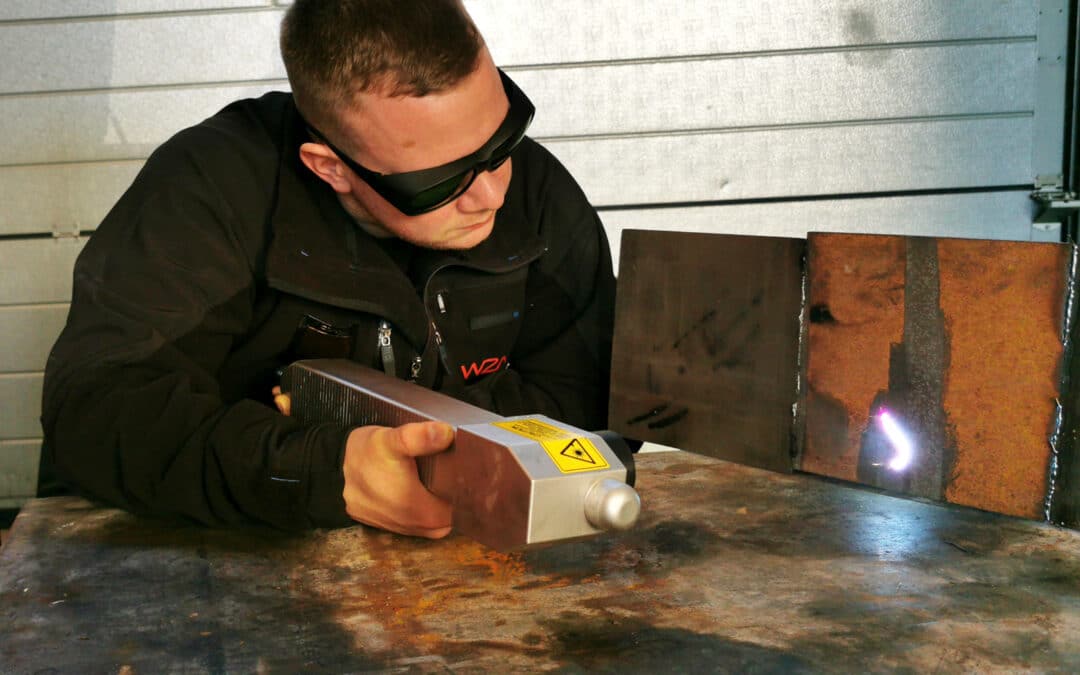
Laser graffiti removal means lifting tags, scrawls, and coatings off a surface with a laser beam, without chemicals, sand, or a pressure washer. Where traditional graffiti removal wears down stone, spreads solvent waste, and needs water, laser lifts the paint without touching the surface and leaves the original surface underneath, ideally without any new damage. This is exactly what makes the method interesting for sensitive facades, brick, and monuments.
In this article, we go through how laser graffiti removal works in practice, why it’s especially well suited to sensitive stone and brick surfaces, how it compares to pressure washing, sandblasting, and chemical graffiti removers, and what public-sector bodies and property owners should keep in mind. Read more about the method in our main article, Laser Cleaning – What It Is and What It’s Used For.
W2M Industries Oy is a Finnish company founded in 2017. Our products are made in Finland, and every delivery includes operational training and orientation. You get the machine, training, service, and spare parts from the same company.
Removing Graffiti Without Chemicals
Laser graffiti removal is a method where short, powerful laser pulses vaporize the paint and coating layer off a surface without leaving a mark on the base material itself, once the parameters are set correctly. The method is contact-free, uses no liquids or gases, and involves no wearing parts.
The technique relies on a phenomenon called ablation: the laser’s energy is focused on a thin surface layer, which heats up so quickly that the paint lifts off and vaporizes. Because graffiti paint and the stone or brick underneath react to the laser differently, a well-adjusted laser removes the tag while treating the base material in a controlled way. This is a fundamental difference from abrasive or solvent-based removal, where the surface material itself is also put under stress.
The practical advantage comes down to three words: laser cleaning is contact-free, chemical-free, and free of consumables. There’s no sand or solvents involved, you avoid wash water running down the facade, and the resulting waste doesn’t need to be handled as hazardous waste the way it does with chemical removal. For graffiti removal, which is often done on the street, close to pedestrians and in changeable weather, this cuts down on both cleanup and environmental risk.
Laser cleaning also isn’t hot work the way welding is, it’s very quiet compared to sandblasting, and it can be done by one person. This is a big difference from pressure washing, for example, which needs water hoses, drainage considerations, and often more than one person. The laser is, however, a high-energy, regulated technology: the work is always done with laser safety glasses and a respirator, according to the work instructions, and with the area cordoned off. That’s why operational training is included with every W2M machine.
An important caveat right from the start: laser doesn’t automatically mean zero damage on every surface. The surface and the parameters are what decide that. The type of paint, the number of layers, the porosity of the stone, and the condition of the existing surface all affect how gently the tag lifts off. This is exactly why a test clean on a small, inconspicuous area is always done first on sensitive targets.
Graffiti isn’t just one kind of paint, either. Spray paints, markers, opaque acrylics, and specialty coatings all behave differently under the laser, and the same wall can contain several overlapping layers from different times. This is one reason laser graffiti removal should be planned around the target, not the brand: what matters most isn’t the wattage, but how well the power and pulse match this particular paint and this particular surface. In practice, the operator identifies the target, chooses starting settings on the side of caution, and adjusts during the work, and this is part of the training included with every W2M delivery.
Another practical advantage is how clean the work is. Since the method doesn’t spread sand, water, or solvent, the work area stays tidy and is easier to cordon off in the middle of a city. Loose particles are captured with local extraction or a vacuum, which also keeps dust nuisance to pedestrians to a minimum. In many locations, this, not just raw removal power, is what settles the decision when work is done close to people passing by or next to a sensitive green space.
Sensitive Surfaces (Stone, Brick, Monuments)
Graffiti rarely lands on a flat, new steel sheet. Most often the tag is on natural stone, a rendered wall, brick, concrete, or a decorative detail on an old building. These are exactly the surfaces where abrasive or solvent-based removal is risky: sandblasting roughens and thins stone, and a chemical agent can penetrate porous stone and leave shadows or discoloration.
Laser cleaning’s strength on these surfaces is controllability. Adjustable power and the right pulse type make it possible to direct the energy at the paint layer rather than the stone. On sensitive substrates, the W2MCF collection’s MOPA pulse laser, which offers precise pulse shaping, gives more room to fine-tune than the continuous-wave (CW) W2MCW collection, which is aimed at heavier material removal. In practice, the method proceeds on the side of caution: starting with gentle settings and a test clean, and increasing power only as much as removing the paint requires.
It’s honest to say that no method is entirely risk-free on old, valuable surfaces. Old render can be weak, paint can have penetrated deep into porous stone, and a monument’s patina can be part of what needs protecting. That’s why work on built-heritage sites is always planned together with whoever is responsible for the site. In Finland, the Finnish Heritage Agency (Museovirasto, Finnish only) is responsible for the principles of built-heritage care, and cleaning a protected site always requires a site-specific assessment and, where needed, a permit process.
Comparison: Laser vs. Pressure Washing vs. Sandblasting vs. Chemical Graffiti Removers (Sensitive Surfaces)
Below is a general picture of four common methods on sensitive stone, brick, and concrete surfaces. The comparison is indicative, since the exact result depends on the target, the paint, and the surface’s condition.
| Comparison point | Laser cleaning | Pressure washing | Sandblasting | Chemical graffiti removers |
|---|---|---|---|---|
| Surface damage on sensitive stone | Minor, when parameters are right; test clean always first | Water penetrates porous stone; mechanical stress | Roughens and thins stone, irreversible | Can corrode, leaves shadows/discoloration |
| Chemical and water waste | No chemicals, no wash water | Large amounts of wash water, runoff on the facade | Sand/grit waste, dusty | Solvent waste, hazardous-waste handling |
| Suitability for stone/brick/concrete | Stone, brick, concrete – adjustable to the target | Varies; water is a problem on porous surfaces | Poor on sensitive, porous surfaces | Varies by agent; testing mandatory |
| Follow-up work | Little post-cleaning, no rinsing | Drying, cleaning up runoff | Sand collection and sorting | Rinsing and neutralization, waste disposal |
Laser cleaning is contact-free, chemical-free, and free of consumables. On sensitive facades, this is exactly what sets it apart from pressure washing, sandblasting, and chemical graffiti removers, though the choice is always made on the target’s terms, not the method’s.
In practice, laser is often the justified choice when the base material needs to stay as untouched as possible, when the target is valuable or protected, or when the work is done somewhere that water, sand dust, or chemicals would be a problem. Sandblasting can be faster on large, non-valuable concrete surfaces, and chemical agents suit certain specialty targets. The best starting point is always to name the surface first and choose the method to match.
Facades and the Public Sector
Graffiti is typically an ongoing cost for cities, housing companies, and property owners. Tags get removed, and a few weeks later the same wall is tagged again. In that case, the method’s total cost and repeatability matter more than the price of a single removal job.
From a public-sector perspective, laser cleaning has a few concrete advantages. First, the environmental angle: no chemicals, no wash water going into the drains, no sand waste to sort. This makes work easier especially near waterways, sensitive green spaces, or dense urban environments. Second, worker safety and disruption: laser is quiet and can be done by one person within a cordoned-off area, which cuts down on noise and dust nuisance to pedestrians compared to sandblasting. Third, portability: the W2MCF collection is designed for lighter, more mobile work, which suits fieldwork where targets are spread across a city.
From a procurement standpoint, it’s worth looking at total cost rather than a single removal job. Since a laser cleaning machine has no consumables, each additional cleaning doesn’t add to material cost the way sand or solvents do. On walls that get tagged repeatedly, where the same spot is cleaned several times a year, this changes the calculation significantly. An owned or rented machine also keeps response time in your own hands: a tag can be removed right away without a separate subcontracting chain.
Using laser in public procurement is always also a safety and liability question. The machine is high-energy, the work area has to be cordoned off, and the operator needs proper training and protective equipment. Responsibility for laser equipment safety and market surveillance in Finland is split between several authorities: Tukes (the Finnish Safety and Chemicals Agency) oversees the safety of technical equipment generally, while the Radiation and Nuclear Safety Authority (STUK) specifically handles oversight of laser radiation safety. Guidance on an employer’s obligations around laser safety at work is available from Finland’s Occupational Safety and Health Administration (Finnish only). In procurement, it’s worth confirming not just the method’s suitability for the target but also that training and safety orientation are part of the delivery, since both are included with a W2M delivery.
For municipalities and the public sector, laser cleaning has several uses beyond graffiti removal: removing rust and paint from furniture and structures, preparing bridge structures, and maintaining metal surfaces. If you’d like to test the method on your own target before a procurement decision, the machine can also be rented for a project, training included.
Example Applications
Laser cleaning is used internationally on many kinds of surfaces where the base material needs to be preserved. The following are illustrative descriptions of the method and general industry examples that show what laser cleaning is suited for, not individual confirmed W2M customer projects.
- Conservation of historical buildings and monuments. Laser cleaning is used, among other things, for the gentle cleaning of facades on historical buildings, stone statues, and memorials, since the method allows dirt and paint layers to be lifted without abrasive damage to the stone. In conservation work, this is always done under expert supervision and via a test clean.
- Graffiti removal from city facades. Removing tags and scrawls from natural stone, brick, and concrete facades is a typical urban use case, where avoiding chemical and water waste is an advantage.
- Cleaning the surfaces of monuments and memorials. Cleaning patinated or tagged memorials calls for an adjustable, controlled method, and laser is well suited to this once the parameters are chosen to match the surface.
- Removing coatings from concrete structures and fixtures. Removing old coatings, stickers, and paint layers from concrete and metal in public spaces.
Our confirmed customers’ use cases are concentrated in metal industry, car repair, and training. For example, G-Tronic Oy uses laser to remove rust from metal surfaces, and Bemu Expert uses a W2M laser cleaning machine in repair shop work. Graffiti removal on stone, facades, and monuments is presented in this article as a suitability of the method, which W2M can confirm on a case-by-case basis with a test clean.
Frequently Asked Questions
Does laser graffiti removal damage stone or brick?
Not necessarily, when power and pulse type are set correctly and a test clean is done on the target first. Paint and stone react to the laser differently, so a properly controlled laser removes the tag while treating the base material carefully. That said, no method is entirely risk-free on old, porous, or valuable surfaces, so a test clean is always the first step.
Is laser suitable for sensitive monuments and protected buildings?
Laser is well suited to gentle cleaning of sensitive surfaces, since power can be adjusted precisely. On protected sites, though, the work always has to be planned together with whoever is responsible for the site, and it may require permits. The Finnish Heritage Agency is responsible for the principles of built-heritage care, and monument cleaning is done under expert supervision.
Does graffiti removal need chemicals or water?
No. Laser cleaning is a contact-free, chemical-free method that’s free of consumables: it uses no liquids, gases, or wearing parts. This means no wash water runs down the facade and no solvent residue is left behind, and the environmental impact is lower than with pressure washing or chemical removal.
Is laser facade cleaning quiet and safe for pedestrians?
The method is very quiet compared to sandblasting and can be done by one person within a cordoned-off area, which cuts down on noise and dust nuisance. Laser is still high-energy, though, so the work area is cordoned off and the operator wears laser safety glasses and a respirator. We don’t claim the method is entirely risk-free; safety comes from training, protective equipment, and the right working method.
How many layers of graffiti can laser remove at once?
It depends on the type of paint, the number of layers, and the surface’s condition. A thin tag lifts off with lighter settings; a thick or repeatedly painted spot needs more energy or several passes. An exact figure can’t be given in advance; the right approach becomes clear during the test clean. Describe your target and we’ll assess suitability.
What does laser graffiti removal cost?
A fixed price can’t be given for site-specific cleaning work, since it depends on the surface, the amount of graffiti, and the target’s location. Request a quote. If you’re considering buying your own machine, mini laser cleaners start at €5,500 (VAT 0%), with portable models priced upward from there depending on power. The machine can also be rented: product and safety training is €75 (free of charge with a weekly rental).
Can graffiti removal be done on-site in different parts of a city?
Yes. The W2MCF collection is designed for lighter, more mobile work, so the machine is portable and suits fieldwork on facades. This is an advantage for municipalities and property maintenance whose targets are spread out. All that travels with the operator is the machine and protective equipment, no water hoses, sandbags, or chemical containers.
Should I buy my own machine or rent one?
If graffiti and paint removal is done regularly, your own machine pays for itself, since it has no consumables. For a one-off or seasonal need, renting makes the most sense: you get full training and safety orientation and can test the method on your own target before investing. We recommend renting and trying it out before deciding to buy.
Request a Quote or Rent a Machine for Testing
W2M Industries Oy is a Finnish company founded in 2017. Our machines are made in Finland, and every delivery includes operational training, safety orientation, and a 24-month warranty (12 months on the mini cleaners).
Not sure whether laser is right for your graffiti or coating removal job? Rent the machine for a project, get full training, and decide only afterward. Describe your target, the surface, the type of graffiti, and the location, and we’ll recommend the right model and pulse type, and arrange a test clean if needed.
Contact us: Juhani Tamminen (Entrepreneur | Laser Sales, Technical Expert), +358 40 709 4605, [email protected]. W2M Industries Oy, Koivulehdontie 2, 01510 Vantaa, Finland.