
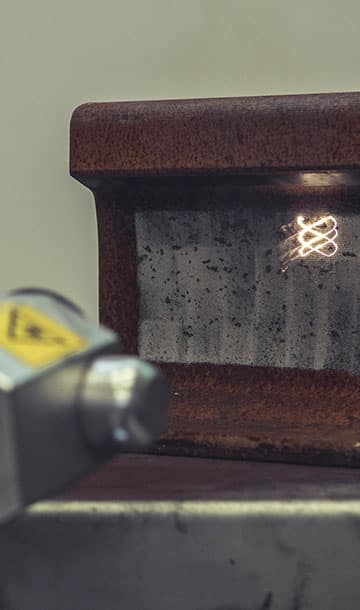
Laser mould cleaning removes residue that builds up inside the mould cavity: rubber combustion by-products, plastic build-up, mould release agent deposits, and casting scale. It’s done without chemicals, without abrasives, and without ever touching the mould surface with steel or abrasive grit. If cleaning the mould between production batches eats into cycle time and stops the line for too long, the problem will be familiar: the mould keeps getting dirty, but its cavity is expensive and delicate, and it can’t be scratched.
In this article, we’ll look at why mould cleaning is difficult, how laser solves it without consumables, why the method doesn’t damage the mould surface, and how it shortens downtime between production runs.
W2M Industries Oy is a Finnish company founded in 2017. Products are manufactured in Finland, and every delivery includes operator training. Read more generally about laser cleaning.
The Challenge of Cleaning Moulds
The mould is the most expensive single tool in production. An injection mould, a rubber vulcanising mould, or a die-casting mould represents a major investment, and its cavity is machined to tight tolerances. That very surface — the one that gives the part its shape and finish — gets dirty on every single run.
The dirt comes from the process itself. In rubber moulds, the rubber compound and vulcanising chemicals leave combustion by-products and sticky carbon deposits that cling to grooves and engravings. In plastic moulds, layers of release agent, degraded polymer, and outgassed plastic residue build up in vent channels. In casting moulds, release agent residue, casting scale, and oxide are left on the surface. As the layer thickens, part dimensions start to drift, surface defects appear, and the reject rate rises.
Traditional cleaning methods are all problematic specifically when it comes to moulds:
- Manual scrubbing and wire brushing takes time, leaves grooves and engravings only half-clean, and can’t reach deep into the cavity’s contours. At worst, it scratches the surface.
- Sandblasting or media blasting removes the dirt, but the abrasive grit wears down the mould surface, rounds off sharp edges, and changes surface roughness.
- Chemical solvent cleaning requires solvents, rinsing, protective equipment, and waste disposal. Solvent vapours are an occupational health risk, and the mould often has to be disassembled for cleaning.
- Ultrasonic cleaning requires removing the mould or its parts, transporting them to a cleaning tank, and drying them — a long downtime for every wash.
The core problem for both mould makers and mould-using production lines is the same: the mould keeps getting dirty, but every traditional cleaning method either takes too much time, risks the mould surface, or produces chemical waste. This creates a real cost — not so much in the price of cleaning itself, but in lost production time and the mould’s shortened service life.
Laser Cleans Moulds Without Chemicals or Abrasives
Laser cleaning removes dirt with light. A pulsed laser’s short, powerful pulse of light hits the layer of dirt and vaporises it instantly. Rubber carbon deposits, plastic residue, release agent, and oxide come away layer by layer. The mould steel underneath reflects most of the energy and is left untouched, because the contaminant and the metal react to the light differently. No liquids, gases, or abrasive grit are fed into the machine, and it has no wearing parts.
In practice, in a mould shop, this means a few concrete things. Cleaning produces no chemical waste and no used sand, so waste disposal is eliminated. The work isn’t classified as hot work, so it can be carried out by one person. The method is also very quiet compared with blasting. No separate cleaning cabinet, solvent bath, or rinsing station is needed around the mould. For protection, the operator wears laser safety glasses and a respirator. Local extraction or a fume extractor is always recommended for capturing vaporised particles.
All W2M devices are designed to be easy to use: clear menus and extensive adjustment options make control precise, and comprehensive training is provided during commissioning. The operator directs the beam over the mould cavity, and the dirt lifts away wherever it’s aimed. No mixing ratios, no drying times, no cleaning equipment afterward.
Being chemical-free isn’t just an environmental argument. Exposure to vapours from solvent-based cleaning agents is an occupational health issue worth managing in the workplace. The Finnish Institute of Occupational Health has information on organic solvents (in Finnish) and Tukes has guidance on storing and handling chemicals. When cleaning is done with a laser, the entire chain of solvent exposure — storage, handling, rinsing, disposal — is eliminated from the mould shop’s daily routine. This is also a logistical relief: one less set of safety data sheets, storage cabinets, and hazardous waste pickups to manage.
Doesn’t Damage the Mould Surface
This is the most important benefit of laser mould cleaning. The mould’s value lies in its surface: machining precision, surface roughness, sharp edges, and engraved markings. Every cleaning cycle that wears down that surface shortens the mould’s service life and brings it closer to costly re-machining or replacement.
An abrasive method touches the surface by definition. Sandblasting’s grit spray removes dirt, but it also removes a thin layer of mould steel, rounds off sharp details, and changes surface roughness. Wire brushes and scrapers leave scratches. Repeated dozens or hundreds of times over a mould’s service life, this wear adds up to a measurable change.
Laser doesn’t touch the surface. Energy is directed at the layer of dirt, and cleaning can be adjusted so that it lifts the contaminant while leaving the base material untouched. Pulse power, frequency, and speed are chosen to match the target: different settings for rubber carbon deposits, plastic residue, and casting scale. Properly adjusted, the method lifts dirt away layer by layer and stops at the clean surface. This is exactly why mould cleaning is one of the applications W2M lists for laser cleaning.
Laser can reach in particular where abrasive cleaning can’t: deep engravings, tight grooves, text and logos, vent channels, and complex shapes. The beam follows the surface contour without a physical tool, so the cavity’s fine details are cleaned without being rounded off or filled in.
Laser cleaning is very safe when used correctly. However, laser is a high-energy, regulated technology, and with the wrong settings, any cleaning method can damage a surface. That’s why every W2M delivery includes operator training and orientation.
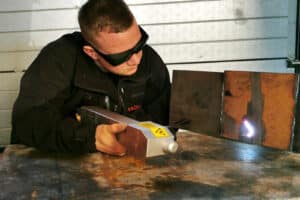
Laser cleaning machine from W2M Laser for cleaning different surfaces.
Fast Cycle Times Between Production Batches
For mould makers and mould-using production alike, time is money in a very direct sense: when the mould is off the line or out of the machine, it isn’t making parts. Downtime for cleaning is often the biggest real cost in mould maintenance.
Laser cleaning shortens this downtime for three reasons. First, the mould can often be cleaned in place, without disassembly, removal, or transport to a cleaning tank. Second, there are no drying or rinsing stages: once the dirt has been vaporised, the mould is clean and immediately ready for use. Third, no post-cleaning is needed: no used sand on the floor, no solvent residue to rinse away.
When the mould can be cleaned quickly and put straight back into production, the changeover between two production batches gets shorter. This means shorter setup time between runs, less planned downtime, and more production hours for the same mould. The size of the benefit depends on the mould’s size, the type of dirt, and how cleaning was previously organised.
The same logic shows up in preventive maintenance. When cleaning is fast and effortless, it can be done more often and more lightly. A short laser clean at the end of every run or shift keeps the cavity continuously clean and doesn’t let carbon deposits build up into a thick layer. This is easier, and better for the mould, than an infrequent, heavy base clean. The same pre-treatment principle applies to welding: a clean surface before the job improves the result, as described in the article Laser Cleaning Before Welding.
The actual benefit depends on the application, so the best way to find out your own savings is to measure them on your own mould. That’s why we also offer the equipment for rent.
Suitable Mould Types
Laser cleaning is suitable for most mould types, but settings and considerations vary by material. Below is a summary of the most common mould types, their suitability for laser cleaning, and considerations for each type. The main point is that laser cleaning is contact-free: it lifts the contaminant without wearing down the mould cavity, but the mould material itself determines how power and parameters are chosen.
| Mould Type | Laser Suitability | Considerations |
|---|---|---|
| Rubber mould (vulcanising) | Good | Removes combustion by-products, vulcanising carbon deposits, and release agent from engravings and grooves. One of the most common applications for mould laser cleaning; often cleaned in place without disassembly. |
| Plastic mould (injection moulding) | Good | Removes release agent deposits, degraded polymer, and outgassed plastic residue from vent channels and the cavity. Power is adjusted so that fine details and texturing aren’t overheated. |
| Casting mould / metal (die-casting, permanent mould) | Good | Removes oxide, casting scale, and release agent residue from heavy-duty mould surfaces. Tolerates higher power; a more heavy-duty machine suits demanding, continuous use. |
| Composite mould (reinforced plastic, tooling) | Case-by-case | Laser is suitable for removing surface residue, but the composite material itself is heat- and energy-sensitive. Requires cautious settings and testing — confirm suitability case by case before production use. |
In addition to the mould material, the nature of the job affects equipment choice. For mould cleaning, we generally recommend the W2MCF collection. The principle is the same as in all laser cleaning: power and machine are chosen to match the target. Tell us what kind of moulds you clean and how often, and we’ll recommend the right power class and pulse type.
Request a Quote, Book a Demo, or Rent a Machine to Try
W2M Industries Oy is a Finnish manufacturer of laser cleaning machines. Every delivery includes operator training, orientation, and a warranty (24 months for W2MCF/W2MCW, 12 months for mini cleaners).
Get in touch:
Juhani Tamminen (Laser Sales, Technical Specialist)
+358 40 709 4605, [email protected]
W2M Industries Oy, Koivulehdontie 2, 01510 Vantaa, Finland.
Frequently Asked Questions
What does laser mould cleaning mean?
Laser mould cleaning means removing contaminants from the mould cavity using laser light. A pulsed laser vaporises dirt, rubber carbon deposits, plastic residue, release agent, and oxide layer by layer, without ever touching the mould surface with abrasive grit or steel. The method is contact-free: it uses no chemicals, no sand, and no consumables.
Does laser cleaning damage the mould surface?
Not when properly adjusted. The laser targets the layer of dirt and doesn’t wear down the mould steel underneath, unlike sandblasting or wire brushing. Power, frequency, and speed are chosen to match the mould material, so the contaminant lifts away and the surface is left unchanged. Preserving the surface is the most important benefit of laser mould cleaning. That said, laser is still a high-energy method, so settings and training matter.
Is laser cleaning suitable for rubber and plastic moulds?
Yes. Laser cleaning of rubber moulds removes vulcanising carbon deposits and combustion by-products even from deep engravings, and plastic moulds are cleared of release agent deposits and polymer residue. Both are common applications for mould laser cleaning. Sensitive details and texturing on plastic moulds are accounted for by adjusting power.
What about casting or metal moulds?
Casting moulds clean up well with laser: the method removes casting scale, oxides, and release agent residue from heavy-duty mould surfaces. Casting and metal moulds tolerate higher power, so a more heavy-duty machine, such as the W2MCW collection, is recommended for demanding, continuous use.
Does the mould need to be disassembled for cleaning?
Usually not. One benefit of laser cleaning is that the mould can, in many cases, be cleaned in place without disassembly, removal, or transport to a cleaning tank. This shortens downtime between production batches. The exact situation depends on the mould’s construction and cavity geometry.
How much does laser cleaning speed up mould changeovers?
The benefit depends on the mould’s size, the type of dirt, and how cleaning was previously organised, so we don’t quote a fixed figure. The speed comes from three factors: the mould is often cleaned in place, there are no drying or rinsing stages, and no post-cleaning is needed. The best way to find out your own savings is to measure them on your own mould. That’s why we also offer the equipment for rent.
Which machine should I use for mould cleaning?
For light, mobile work, the W2MCF collection’s portable fiber laser cleaner is a good fit; for heavy, continuous industrial use, the W2MCW collection. The machine is chosen based on the mould material, size, and frequency of use. Tell us about your needs, and we’ll recommend the right power class and pulse type.
Can the machine be rented and tested before buying?
Yes. W2M also offers laser cleaning machines for rent, and renting works as the first step on the path to purchase. You can try mould laser cleaning on your own mould, measure the real cycle-time benefit, and only then decide. Rental includes operational and safety training, free of charge with a weekly rental.