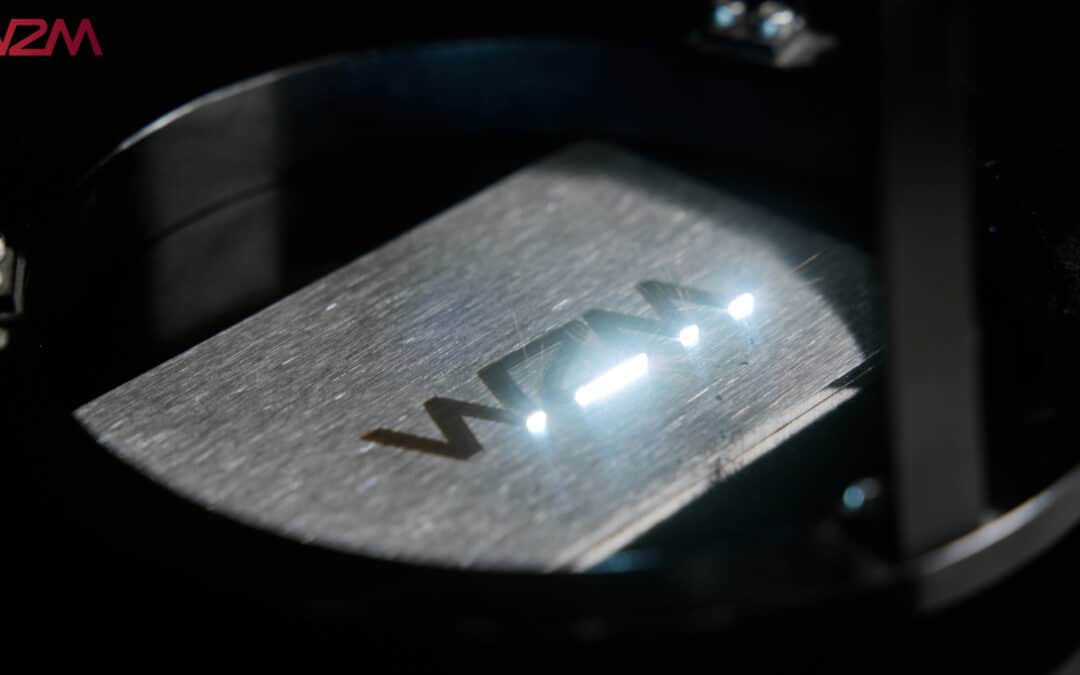
Traceability with laser marking means that a serial number, batch number, barcode, 2D matrix code or QR code is marked directly on the surface of the part. The information then travels with the part through the entire supply chain.
The identifier has to be legible and permanent. This article explains why the identifier should be marked on the part itself, how to choose the code type, what the UDI of medical devices requires and how marking is connected to the production line. Finally we explain when a laser is not the right choice. The machines are presented on the laser marking page.
W2M Industries Oy is a Finnish company founded in 2017. The products are made in Finland, and every delivery includes operator training.
Why the identifier is marked directly on the part
When the identifier disappears, traceability breaks at that point. A label can come off, printing can fade and a worn nameplate is hard to read. The part is then anonymous, even if its data is safely stored in the system.
Applications include brake pads, engine parts, transmission components and spare part identifiers in the automotive sector, and circuit boards, components and enclosure housings in the electronics industry. Serial numbers, batch numbers and CE markings are marked on metal parts.
A focused laser pulse changes the surface in a controlled way, and the mark is created in three ways:
- Thin oxide layer: the color of the surface changes without the mark becoming recessed. This way is typical for stainless steel.
- Vaporization: the laser removes material or coating from the surface. This way is used, for example, in deep marking and on anodized aluminum.
- Subsurface color change: the laser changes the color of the material below the surface without damaging the surface. This way is typical for plastics.
The operator influences the result through power, speed and pulse. The mark withstands heat, chemicals, UV radiation and wear for decades on steel, aluminum, titanium, anodized surfaces and plastics. Durability still depends on the material, the marking method and the operating environment, so in a demanding application it should be verified with a test piece.
| Current marking method | Limitation | With laser marking |
|---|---|---|
| Label or nameplate | Comes off and wears over time | The identifier is created on the surface of the part itself |
| Inkjet printing | Requires ink and consumes supplies | No ink or labels are used |
| Dot peen marking (pin marking) | Relies on mechanical contact, and the tips wear | Non-contact and more precise, especially for small codes |
| Chemical etching | Requires chemicals and waste treatment | No chemicals and no liquid waste |
| Mechanical engraving and stamps | Tools wear and changing them takes time | Changing the batch takes seconds, because the mark comes from the program |
A label or ink can be enough for temporary marking. In traceability applications that require permanence, the total cost of a laser depends on the number of parts marked, so the comparison should be made with your own volumes.
When every part has a different serial number, the marking changes from the program. The marking parameters are saved per material or product, so the same setting repeats the same result every time regardless of the operator.
A large part in place
The identifier of a large part is marked where the part is. The hand unit of the H series is connected to the machine with a 2 or 3 meter connecting cable, and the unit weighs 0.8 kg. The machine is suitable for replacing inspection stamps, labels and nameplates, and for large structures and parts that are laborious to move. In handheld work the work area should be delimited, and the eyes are protected with glasses suited to the wavelength of the laser. Select eyewear, barriers and other protective measures for the laser’s actual parameters and the job-specific risk assessment.
Choosing the code type
A serial number is the simplest identifier: a person reads it without a device, and it identifies the part. Barcodes and 2D matrix codes, such as DataMatrix, are made to be read by a machine, so the reader picks up the identifier straight from the part and numbers do not have to be keyed in by hand. The machines can mark logos, texts, serial numbers, barcodes, 2D matrix codes and QR codes, so one part can hold both a number legible to a person and a code intended for a machine.
The Japanese company Denso Wave published the QR code in 1994. According to Denso Wave, one of four error correction levels is selected when the code is generated, and error correction makes it possible to read the code even if it is soiled or damaged. Higher levels add recovery data and can require a larger symbol. Denso Wave suggests considering Q or H for factory environments where codes get dirty. For a part that is prone to wear, the level should therefore be decided before the first batch.
The smallest character size of the H series machines is 0.15 mm and the smallest marking line width 10 µm. The smallest readable code also depends on the material, the marking method and the reader, so the code should be tried on your own part and with the production’s own reader before the size is fixed.
Three questions before choosing a code
- Who reads the code? A person, a production reader or the customer’s phone.
- How much information is needed? Just a number, or also the batch, dimensions and a link.
- How much surface is available? A small part holds less than a panel.
The machine marks all of the code types listed above, so the use case decides the choice.
Traceability and UDI in medical devices
According to the European Commission’s UDI page, the unique device identifier (UDI) is a numeric or alphanumeric code related to a medical device, which is used to identify certain devices on the market unambiguously. The identifier has two parts: a device identifier (UDI-DI) and a production identifier (UDI-PI). The unique device identification system is laid down in Article 27 of Regulation (EU) 2017/745 on medical devices. The UDI supplements the existing labeling requirements.
The placement of the marking is laid down in Part C of Annex VI to the Regulation. According to section 4.1, the UDI carrier must be on the label or on the device itself and on all higher levels of device packaging, excluding shipping containers. For devices intended to be reused, the carrier must, according to section 4.10, be on the device itself. If the device is cleaned, disinfected, sterilized or refurbished between patient uses, the carrier must be permanent and legible after each such process throughout the intended lifetime of the device. The direct-marking requirement does not apply if any form of direct marking would compromise the safety or performance of the device or if direct marking is technologically infeasible. Application dates depend on the device class; for reusable class I devices, direct marking applies from May 26, 2027. The reference is based on the consolidated version of the Regulation of January 1, 2026, and the text in force is always checked before use.
Medical device applications include surgical instruments and implants, where the marking has to withstand sterilization. Titanium, copper and brass are often marked on products where the mark has to be both permanent and hygienic. A laser marks without mechanical contact, which is important on delicate surfaces and small parts. On stainless steel, the marking method is chosen so that corrosion resistance is preserved in the marked area as well.
The content, format and conformity of the identifier are the manufacturer’s responsibility. According to the Commission’s page, GS1, HIBCC, ICCBBA and IFA have been designated as UDI issuing entities, and the formats each of them uses are described on the page. The marking machine transfers to the surface what the program gives it, and in a line solution the data can come directly from the manufacturer’s ERP or MES system. The durability and legibility of the marking should be tried on a test piece that is taken through the same cleaning and sterilization cycle as the product. The code format must follow the rules of the designated issuing entity.
Marking in the production line
In series production, laser marking is connected directly to the production line, so the identifier comes from the system and not from a manually entered number.
Our range extends from handheld units to robotized production line solutions. We design robotized and machine-vision-based lines together with the customer. The solution synchronizes with the production speed and connects to the customer’s ERP or MES system, so every part gets an identical, documented mark without a constant need for an operator. A line solution is designed case by case, so its price is given in a quote. The prices below are the prices of individual machines.
An identifier is only useful if it looks the same and is read the same way on the first and the thousandth part. Because the parameters are saved per product, the operator only selects the right program. Basic use is learned in one training day, and the delivery includes a commissioning and training package.
The choice of machine depends on the part and the pace:
| Need | Series | Details | Price (excl. VAT) |
|---|---|---|---|
| A large part that is not moved | H series (20–100 W) | Hand unit 0.8 kg, connecting cable 2 or 3 m, marking area 110 × 110 mm or 70 × 70 mm, smallest character 0.15 mm | €9,995–€18,500 |
| Production and a larger marking area | R series (20–50 W) | Marking area 150 × 150 mm (up to 300 × 300 mm), smallest marking line width 0.01 mm | €9,995–€12,250 |
| Single parts and smaller marking | LD20i III (20 W) | Affordable entry-level model, marking area 100 × 100 mm or 50 × 50 mm, weight 4 kg | €5,750 |
| A fully automated line | Line solution | Designed with the customer, connection to an ERP or MES system | According to quote |
All eight marking machines have a 2-year factory warranty and run on a single-phase 220 V connection. Leasing is available for every model.
When a laser is not the right choice
Temporary marking. A label or ink is enough when the mark does not have to last.
Plastics. Plastics react to a laser in different ways, and the mark is created as a subsurface color change. Your own part is therefore tested before production.
Stainless steel. If the corrosion resistance of the marked area matters, the marking method and settings are chosen accordingly, and the result is checked on a test piece.
Other materials and surfaces. The method suits most materials used in industry. In uncertain cases a test decides.
Frequently asked questions
What information can be stored in a laser mark?
The mark can contain logos, texts, serial numbers, batch numbers and CE markings, as well as barcodes, 2D matrix codes and QR codes. One part can be marked with both a number legible to a person and a code intended for a machine. The content of the code comes from the program, so changing the batch takes seconds. The marking time per part depends on the size of the mark and the material, so it is measured on a test piece.
Can a QR code be read if the mark is damaged?
Yes, within the limits of the code’s error correction. The level is selected when the code is generated. Higher levels add recovery data and can require a larger symbol. Denso Wave suggests considering Q or H for factory environments where codes get dirty.
What does UDI mean?
UDI means unique device identifier. It is a unique identifier related to a medical device. The unique device identification system is laid down in Article 27 of Regulation (EU) 2017/745. The identifier consists of a device identifier (UDI-DI) and a production identifier (UDI-PI). The UDI supplements the existing labeling requirements. With laser marking, the identifier can be made permanently on the device itself.
Does the UDI have to be marked on the device itself?
Not always. According to section 4.1 of Part C of Annex VI to the Regulation, the UDI carrier must be on the label or on the device itself and on all higher levels of device packaging, excluding shipping containers. For devices intended to be reused, section 4.10 requires direct marking on the device itself, unless any form of direct marking would compromise safety or performance or direct marking is technologically infeasible. Application dates depend on the device class; for reusable class I devices, direct marking applies from May 26, 2027. Check the requirement for your own product in the Regulation and according to the device class.
Can a marking machine be connected to an ERP or MES system?
Yes. We design robotized and machine-vision-based lines that connect to the customer’s ERP or MES system and synchronize with the speed of production. Tell us the pace of your production and your current system, and we will go through the solution.
How much does a machine suitable for traceability marking cost?
The prices of our marking machines range from €5,750 to €18,500 depending on the model (excl. VAT). The cheapest is the W2M-MF-LD20i III, which costs €5,750 (excl. VAT) and is intended for smaller marking and single parts. A 60-month lease is available for every model, for example €103.50 per month (excl. VAT) for the LD20i III, with a residual value of about 10 percent. All machines have a 2-year factory warranty.
Does the part have to be brought to the machine for marking?
Not always. The hand unit of the H series is taken to the part on the end of the connecting cable, which suits large structures and parts that are laborious to move. The machine then replaces inspection stamps, labels and nameplates directly on site. The connecting cable is 2 or 3 meters long, so the spot to be marked has to be within its reach.
What protective equipment is needed in marking work?
Operating a laser machine requires protective equipment, and the eyes are protected with glasses suited to the wavelength of the laser. OD8+ safety glasses filter wavelengths of 900–1100 nm, are intended for fiber lasers (welding, cleaning and marking) and cost €150 (excl. VAT). The wavelength of our marking machines is 1064 nm. For delimiting the work area, laser safety curtains and a protective acrylic screen are available, as well as W2M Smoke Cleaner extractors. Select eyewear, barriers and other protective measures for the laser’s actual parameters and the job-specific risk assessment.
Request a quote
Tell us what the identifier has to contain, such as the code type, data content, the material and size of the part, and the pace of production. We will test your part in a free method analysis and tell you what result to expect. Juhani Tamminen (laser sales, technical expert) will help you choose a machine or a line solution: 040 709 4605 (+358 40 709 4605), [email protected]. W2M Industries Oy, Koivulehdontie 2, 01510 Vantaa.