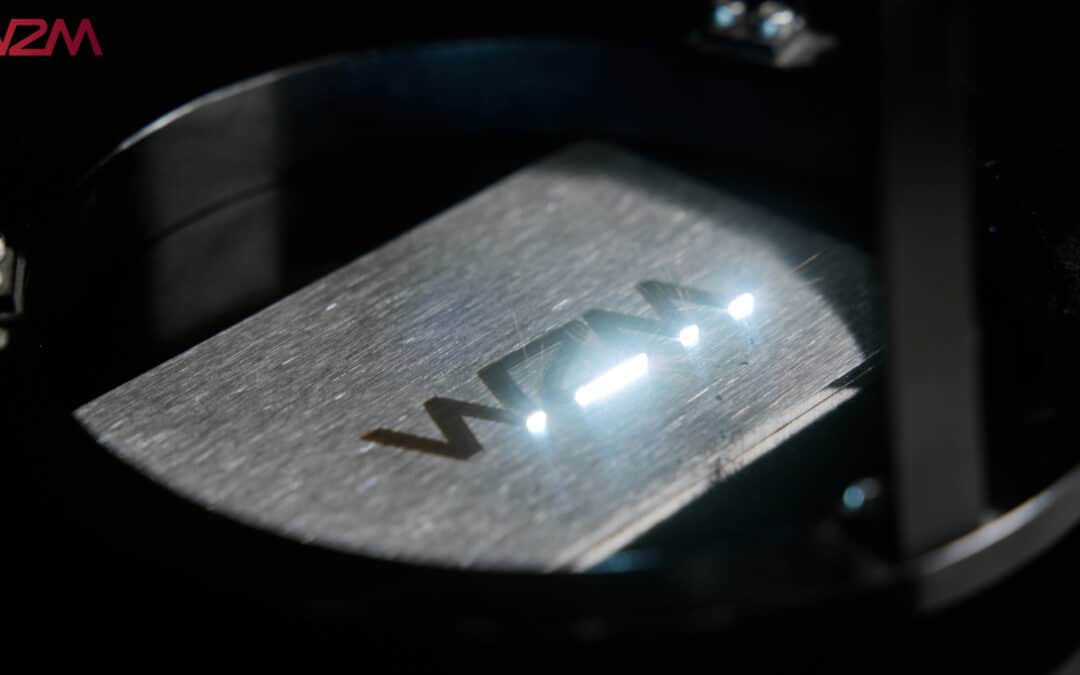
Laser marking of metal is a non-contact method in which a fiber laser changes the surface of the metal so that a logo, text or code becomes part of the material. Stainless steel, anodized aluminum and unalloyed steel get their mark in different ways, so the marking method and settings are chosen according to the material.
Our marking machines and their prices are presented on the laser marking page.
W2M Industries Oy is a Finnish company founded in 2017. The products are made in Finland, and every delivery includes operator training.
How the mark is created
The laser hits the surface as a focused pulse and changes it in a controlled way. The operator influences the result with three parameters: power, speed and pulse. In our machines the parameters are saved per material or product, so the same setting repeats the same result every time regardless of the operator.
On metals the mark is created in two ways. In oxide layer marking the color of the surface changes within a thin oxide layer and the material stays on the same level. This is typically used on stainless steel. In vaporizing marking the laser removes material or coating, and the method is used, for example, in deep marking and on anodized aluminum.
| Metal | Marking method | What to watch | Applications |
|---|---|---|---|
| Steel | Oxide layer | The mark shows as a color change | Serial numbers, batch numbers, CE markings |
| Stainless steel | Oxide layer | Corrosion resistance must not be weakened in the marked area | Cutlery, surgical instruments |
| Anodized aluminum | Removal of the anodized layer | Layers vary in thickness and color | Enclosures, panels, consumer electronics parts |
| Titanium, copper, brass | Chosen according to the material | Tested on your own part | Medical devices, jewelry |
Steel and stainless steel
Steel and stainless steel are usually marked with oxide layer marking. The color of the surface changes and no material is removed. On stainless steel, corrosion resistance is the deciding factor.
The chromium in stainless steel reacts with oxygen and forms a thin protective passive film on the surface, which repairs itself in an oxidizing environment. In welding, the importance of surface oxidation is clearly visible: under the heat tint that forms next to the weld, the chromium content is locally depleted, which weakens corrosion resistance. We cover this in the article Laser cleaning of aluminum and stainless steel.
In oxide layer marking a color change is made on the surface on purpose, so on stainless steel the marking method is chosen so that corrosion resistance is preserved in the marked area as well, and the settings are sought separately for stainless steel. The program for ordinary steel should not be copied as it is. Whether corrosion resistance is sufficient in your own operating environment is verified on a test piece. No general promise can be given, because the environment, the steel grade and the surface treatment vary.
Anodized aluminum
Marking anodized aluminum is based on a layer that is already on the surface. In anodizing, the part is immersed in a solution and an electric current grows a protective oxide layer on the surface. The layer can be dyed, so an anodized enclosure can be black, blue or red.
The laser removes the thin anodized layer at the point of the mark, and the result is a clear, sharply defined contrast against the color of the surface. The mark requires no paint or label. The method suits enclosures, panels and consumer electronics parts.
The thickness and color of the layer vary. The test piece should be taken from the same anodizing batch as the production parts.
The marked spot has been removed from the anodized layer. Anodizing protects aluminum from corrosion, so the durability of the marked spot should be tested separately if the part ends up, for example, in a marine climate or an environment containing salt.
Permanence and legibility
As the manufacturer, we state that the mark withstands heat, chemicals, UV radiation and wear for decades. Actual durability depends on the material, the marking method and the stress, and it can be verified on a test piece in your own operating environment.
The laser and the most common alternatives:
- A label or nameplate is a separate part that can come off and wear. A laser marks directly on the metal surface.
- Inkjet printing needs ink and consumes supplies. A laser uses no consumables.
- Dot peen marking (pin marking) relies on mechanical contact, and the tips wear in use. A laser is non-contact and more precise, especially for small codes.
- Etching needs chemicals and their waste treatment. A laser produces no liquid waste.
A traditional method can still be enough if the mark is temporary or the product changes often and permanence does not matter.
The legibility of the mark depends on contrast and character size. On anodized aluminum the contrast comes from the color difference between the layer and the metal, and on steel from the color change of the oxide layer, the clarity of which is affected by the settings. Our machines can mark logos, texts, serial numbers, barcodes, 2D matrix codes and QR codes. If the code has to be read automatically, try the marked part with your own reader in your own production before the whole batch is marked.
Marking machines for metal
Our online store has three marking machine ranges. All are air-cooled fiber lasers, and all have a 2-year factory warranty.
| Range | Power | Price (excl. VAT) | Marking area | Other |
|---|---|---|---|---|
| W2M-MF-H | 20–100 W | €9,995–€18,500 | 110 × 110 mm or 70 × 70 mm | Hand unit 0.8 kg, connecting cable 2 or 3 m, machine weight 10–20 kg |
| W2M-MF-R | 20–50 W | €9,995–€12,250 | 150 × 150 mm, up to 300 × 300 mm | Machine weight 100 kg, dimensions 1,300 × 600 × 800 mm |
| W2M-MF-LD20i III | 20 W | €5,750 | 100 × 100 mm or 50 × 50 mm | Machine weight 4 kg, affordable entry-level model |
In the H series the thinnest marking line is 10 micrometers and the smallest character 0.15 millimeters. In the R series the thinnest line is 0.01 millimeters. A leasing contract is available for all models. For example, a 60-month lease on the W2M-MF-20H is €185 per month (excl. VAT) with a residual value of about 10 percent.
The hand unit takes the marking to the part when the part cannot be moved. The machine replaces an inspection stamp, label or nameplate. One marking area is 110 × 110 mm or 70 × 70 mm, so the size of the mark and the shape of the part should be mentioned already in the first conversation.
The operator protects their eyes with safety glasses intended for fiber lasers. In our online store, OD8+ safety glasses cost €150 (excl. VAT), and they are intended for fiber laser welding, cleaning and marking work. If the laser removes coating or an anodized layer, also ask in your quote request about collecting the fumes and dust that are produced. Select eyewear, barriers and other protective measures for the laser’s actual parameters and the job-specific risk assessment.
How to test the mark on your own part
- Contact us or book a free demo. You see the machine in use before the purchase decision.
- Free method analysis. We go through your process and needs and test the part. Tell us the metal, any coating or the color of the anodizing, the content and size of the mark, the operating environment, any sterilization or washing, and how long the mark has to last.
- Machine in use. You can buy through the online store or via a quote, and the delivery includes operator training. Basic use is learned in one training day.
Frequently asked questions
Which metals can be marked with a laser?
A laser can mark steel, stainless steel, aluminum, brass, copper and titanium, as well as anodized and coated metals. Steels are usually marked as a thin oxide layer, and on anodized surfaces the laser removes the layer at the point of the mark. If your part is a special alloy or has an unusual coating, we test it in the free method analysis.
How is anodized aluminum marked with a laser?
The laser removes the thin anodized layer at the point of the mark, and the aluminum revealed underneath stands out from the dyed surface. The thickness and color of the layers vary, so the setting should be found on a test piece from the same anodizing batch as the production parts. The corrosion resistance of the marked spot must be tested separately if the part ends up in an environment containing salt.
Does laser marking weaken the corrosion resistance of stainless steel?
The marking method and settings decide. On stainless steel the marking method is chosen so that corrosion resistance is preserved in the marked area as well, and a separate program is saved for it. In the method analysis, tell us what environment the finished product goes into, and verify the result on a test piece before production.
Does laser marking withstand sterilization?
Sterilization resistance is verified with a test on your own part and with your own sterilization method. The mark withstands heat, chemicals, UV radiation and wear, and on surgical instruments the marking has to withstand sterilization. Mention the sterilization method when you agree on the test.
Which machine suits laser marking of metal?
The choice depends on the size of the mark and on whether the part can be moved to the machine. The H series costs €9,995–€18,500, the R series €9,995–€12,250 and the cheapest, the LD20i III, €5,750 (all prices excl. VAT). In the H series the marking is done with the hand unit at the part, and the marking area of the R series is larger.
Can a large metal structure be marked on site?
Yes, when the mark fits in the marking area of the machine. In the H series the marking is done with a 0.8 kg hand unit attached to a 2 or 3 meter connecting cable. One marking area is 110 × 110 mm or 70 × 70 mm, so tell us the size of the mark and the shape of the part before the test.
Can I try the marking before buying?
Yes. We test your own part in the free method analysis and tell you what result to expect. You can also book a free demo, in which you see the machine in use. At the moment only laser cleaning machines are available for rent, so a trial of a marking machine is arranged as a demo and a method analysis.
Can barcodes and QR codes be marked with a laser?
Yes. The machines mark serial numbers, barcodes, 2D matrix codes and QR codes. Legibility depends on contrast and character size, so test the marked code with your own reader. The smallest character in the H series is 0.15 millimeters.
Request a quote
Tell us which metal you are marking, and we will test your part and suggest a suitable model. Juhani Tamminen (laser sales, technical expert) will help you choose the machine according to the size of the mark and the material: 040 709 4605 (+358 40 709 4605), [email protected]. W2M Industries Oy, Koivulehdontie 2, 01510 Vantaa.