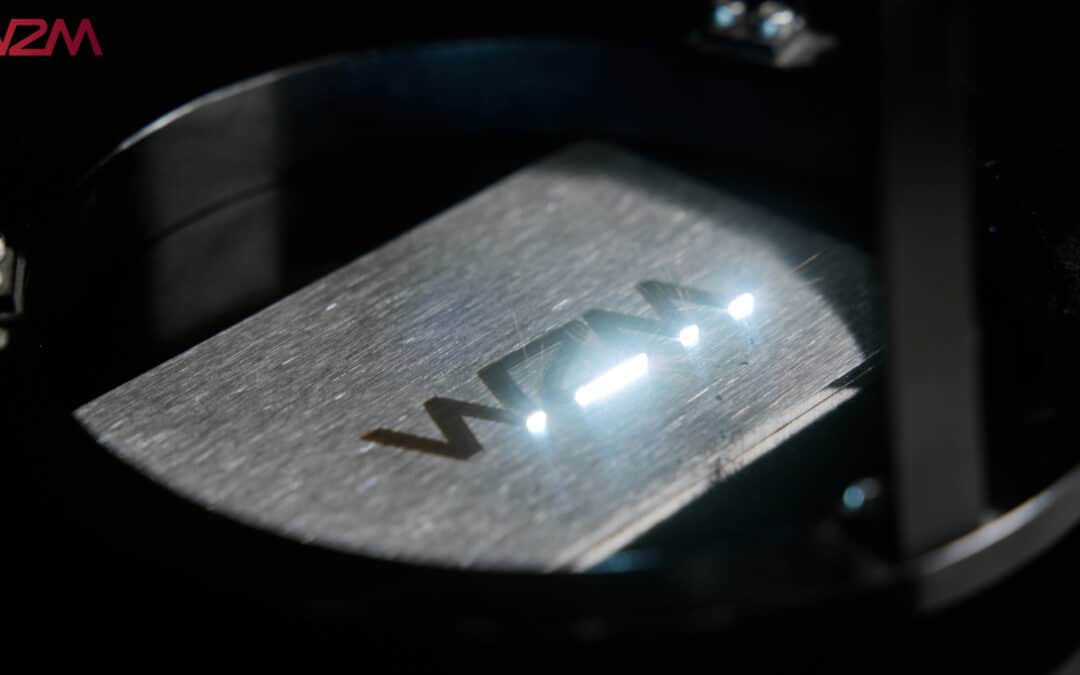
Laser engraving is a form of laser marking in which the laser removes material or coating from the surface of the part. Not all marks made with a laser are engravings, and the difference decides whether the surface becomes recessed, whether the corrosion resistance of stainless steel is preserved and whether the mark is visible on a dark surface.
The range with prices is on the laser marking page.
W2M Industries Oy is a Finnish company founded in 2017. The products are made in Finland, and every delivery includes operator training.
Laser engraving and laser marking
Engraving is one of the three ways of laser marking, and in it material is physically removed. Laser marking also covers color changes in which the surface does not become recessed. Our marking machines make the mark in three ways. The operator influences the result through power, speed and pulse. The machine saves the settings per material or product, so the same setting repeats the same result regardless of who operates the machine.
| Method | What happens to the surface | Does the surface become recessed | Typical application |
|---|---|---|---|
| Thin oxide layer | The surface layer changes its color | No | Stainless steel |
| Vaporization (engraving) | The laser removes material or coating | Yes, or the coating is removed | Deep marking, anodized aluminum |
| Subsurface color change | The color changes below the surface without damaging the surface | No | Plastics |
If you ask for engraving on stainless steel, the right method may still be oxide layer marking. On stainless steel the marking method is chosen so that corrosion resistance is preserved in the marked area as well. Tell us therefore what is required of the mark, and choose the method on the basis of the material.
Compared with traditional marking methods, a laser is non-contact, so there is no wearing tip or tool. In mechanical engraving and stamping the tools wear, and changing them takes time. Changing the mark for the next batch takes seconds with a laser, because the settings are saved per material or product. A traditional method can still be enough if the mark is temporary.
Materials
Our marking machines are fiber lasers with a wavelength of 1064 nanometers. Metals absorb the light of a fiber laser at about 1000 nanometers better than the light of a CO2 laser, so a fiber laser suits metals. The material decides which of the three methods is chosen.
Metals
The metals that can be marked are steel, stainless steel, aluminum, brass, copper and titanium, as well as anodized and coated surfaces. Steel and stainless steel are usually marked with oxide layer marking, in which the color of the surface changes without a recess. In coated metals the laser can remove the coating at the point of the mark, and the metal underneath forms the mark.
On anodized aluminum the laser removes the thin anodized layer at the point of the mark, and the mark gets a sharply defined contrast against the color of the surface. In anodizing, the part is immersed in a solution and an electric current grows a protective oxide layer on its surface, which can also be dyed at the same time. At the marked point the protective layer has been removed, so if the part has to withstand a corrosive environment, the effect of the mark should be verified on a test piece.
Titanium, copper and brass are often marked on products where the mark has to be both permanent and hygienic, for example medical devices and jewelry.
Plastics
Laser marking of plastics works on both rigid plastics and plastic films, but plastics react to a laser in different ways. Plastics almost always contain colorants and additives, which affect the result of the marking. That is why we test the customer’s own part before production as part of the free method analysis.
Plastics that contain chlorine produce a corrosive gas when treated with a laser, which can damage the equipment. According to the Finnish Institute of Occupational Health’s memo on working with PVC plastic (in Finnish), PVC starts to form hydrogen chloride already at 180 degrees, and impurities in the workplace air can be reduced with effective local exhaust ventilation and sufficient general ventilation. Tell us about PVC before the first trial.
Wood, glass and stone
Wood, glass and stone are not on our material list, and we do not promise a result for them before a test. Marking wood is based on charring of the surface, and glass and stone crack when the laser hits them, which is why they are often better suited to other engraving methods. UV lasers have been developed for engraving glass. This has not been demonstrated with our fiber lasers, so a test should be agreed for marking a glass part.
Depth and precision
Depth is affected by the same settings as any other mark, that is power, speed and pulse, and by the material in addition. Depth figures have not been published for our machines, so the depth on your own part is found out in a test. If you need a specific depth, say so in your first contact. After that the test piece shows whether the power of the machine is sufficient and what kind of mark results.
On anodized aluminum the depth of the mark is at most of the order of the thickness of the anodized layer, because the laser removes the layer at the point of the mark. Laser engraving on anodized aluminum lightens the color and reveals the white or silver aluminum underneath, and dark anodizing gives the strongest contrast.
In the H series marking machines the smallest marking line width is 10 micrometers, the smallest character size is 0.15 mm and the marking area is 110 × 110 mm or 70 × 70 mm. The marking speed is 25,000 mm/s. In the R series the marking area is 150 × 150 mm (up to 300 × 300 mm) and the smallest marking line width is 0.01 mm. In the LD20i III model the marking area is 100 × 100 mm or 50 × 50 mm and the speed 7,000 mm/s. Even a small serial number or code therefore fits on a small part, but legibility also depends on the surface, and a test piece verifies it.
Durability and limits
The mark is a change in the composition of the surface itself, so it does not come off like a label or printing. The mark withstands heat, chemicals, UV radiation and wear for decades. It is still worth verifying the requirement with a test on your own part if the part will be sterilized or exposed to a corrosive environment or heavy wear.
The method should be checked before purchase in the following cases:
- You need a groove of a specific depth that has not been verified on a test piece.
- The part is wood, glass or stone, which are not on our material list.
- The part is PVC or another plastic containing chlorine.
- The mark is temporary, in which case a label or another traditional method may be enough.
Applications
Laser marking is used on products whose identifier has to remain legible throughout their service life:
- Metal parts: serial numbers, batch numbers and CE markings
- Automotive industry: brake pads, engine parts, transmission components and spare part identifiers
- Medical devices: surgical instruments and implants, where the marking has to withstand sterilization
- Electronics: circuit boards, components and enclosure housings, marked without contact
- Jewelry and valuables: rings, watches and silverware
- Consumer goods: cutlery, tools, keys and brand markings
Barcodes, 2D matrix codes and QR codes can also be marked on the same surface. When the part is so large that it cannot be moved, the handheld machine is taken to the part. The machine can then replace an inspection stamp, label or nameplate, and the marking is done directly on site.
Our marking machines
Our range has three series: W2M-MF-H, W2M-MF-R and W2M-MF-LD20i III.
| Series | Power ratings | Price (excl. VAT) | Marking area | Machine weight |
|---|---|---|---|---|
| W2M-MF-H | 20, 30, 50 and 100 W | €9,995–€18,500 | 110 × 110 mm or 70 × 70 mm | 10–20 kg |
| W2M-MF-R | 20, 30 and 50 W | €9,995–€12,250 | 150 × 150 mm (up to 300 × 300 mm) | 100 kg |
| W2M-MF-LD20i III | 20 W | €5,750 | 100 × 100 mm or 50 × 50 mm | 4 kg |
The hand unit of the H series weighs 0.8 kg, and its connecting cable is 2 or 3 meters long. All models run on a single-phase 220 V connection. All our marking machines have a 2-year factory warranty, and a leasing contract is possible for all models. If the marking has to be connected to a line, we design the line solution together with the customer.
The H series suits jobs where the part cannot be moved, because the hand unit is taken to the part. The marking area of the R series is larger, so the whole mark fits on a bigger surface in one go. The LD20i III is an affordable entry-level model for smaller marking and single parts. Model-specific information is on the product pages of the H series and the R series.
A laser is a high-energy device, and protective equipment is part of the workstation. The OD8+ safety glasses (in Finnish) suited to fiber laser marking filter wavelengths of 900–1100 nm, and they cost €150 in our online store (excl. VAT). When material or coating vaporizes, extraction is almost always needed. For local exhaust ventilation our online store has the W2M Smoke Cleaner XL300 (in Finnish) extractor, priced at €2,730 (excl. VAT). Other equipment is on the protective equipment page. Select eyewear, barriers and other protective measures for the laser’s actual parameters and the job-specific risk assessment.
Frequently asked questions
What is the difference between laser engraving and laser marking?
In laser engraving the laser removes material or coating, and the mark is a recess in the surface or a pattern visible through the coating. Laser marking is the umbrella term that also includes oxide layer marking and subsurface color change, in which the surface does not become recessed. The method is chosen according to the material and the requirements.
Which materials does laser engraving suit?
Among metals, steel, stainless steel, aluminum, brass, copper and titanium are included, as well as anodized and coated surfaces. Among plastics, rigid plastics and plastic films are included. Engraving, that is the removal of material or coating, is typical for deep marking and on anodized aluminum. For other materials, uncertain cases are tested in the free method analysis.
How deep is laser engraving?
The depth depends on the material and the power, speed and pulse settings. On anodized aluminum the depth is at most of the order of the anodized layer. Depth figures have not been published for our machines, so whether a specific depth can be reached is verified on a test piece.
How much does a machine suitable for laser engraving cost?
The prices of our marking machines are €5,750–€18,500 depending on the model (excl. VAT). The cheapest is the LD20i III, and the highest power is 100 W in the W2M-MF-100H. A leasing contract is possible for all models, and all have a 2-year factory warranty.
Can a W2M machine engrave wood or glass?
Wood and glass are not on our material list, so we do not promise a result for them before a test. The surface of wood chars and glass cracks when the laser hits it. Ask for a free method analysis for your part, and we will tell you whether a laser is the right method for it.
Does laser engraving last in use?
The mark is a change in the composition of the surface itself, so it does not come off like a label. It withstands heat, chemicals, UV radiation and wear for decades. For jobs that require sterilization or a corrosive environment, durability should be verified with a test on your own part.
Can I see the machine before the purchase decision?
In the free demo you see the machine in use. For your own part you can request a free method analysis, in which you see what kind of mark the machine makes on your material.
Can a marking machine be connected to a production line?
We design line solutions together with the customer. Tell us the production speed and the system the marking data has to be connected to, and we will assess the solution.
Request a quote
Our rental range includes laser cleaning machines but not marking machines. A marking machine can be bought or acquired with a leasing contract, and trials are done as tests: tell us about the part you want to mark and request a free method analysis or demo. Juhani Tamminen (laser sales, technical expert) will suggest a model and arrange the test of your part: 040 709 4605 (+358 40 709 4605), [email protected]. W2M Industries Oy, Koivulehdontie 2, 01510 Vantaa.