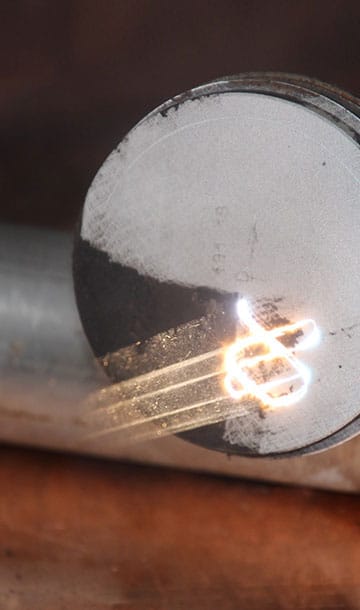
Laser cleaning of cars means cleaning the body, chassis, and individual sheet-metal parts with a laser beam – rust, old paint, and dirt lift off contact-free, without sand, chemicals, or grinding. For restorers and body shops, this solves a familiar problem: thin, old body sheet metal doesn’t hold up to abrasive cleaning, and stripping agents leave their own marks. The laser removes dirt without touching the surface and leaves behind a clean base that’s ready for the next step.
In this guide, we go through how laser cleaning of cars works in practice, why the method suits thin sheet metal especially well, and how it compares to sandblasting, chemical stripping, and grinding. You’ll also get examples from Finnish body shops and a clear picture of when it makes sense to buy a machine and when it’s better to rent one for testing first. If you’d like the broader picture, also read what laser cleaning is and how it works.
W2M Industries Oy is a Finnish company founded in 2017. Our products are made in Finland, and every delivery includes operational training and orientation. You get the machine, training, service, and spare parts from the same company.
Removing rust and paint with a laser
Laser cleaning of cars is a method where short, powerful laser pulses vaporize the rust, paint, and contamination layer off the sheet metal without leaving a mark on the body panel itself. The method is contact-free, uses no liquids or gases, and involves no wearing parts. The same machine removes rust, old paint, primer, and adhesive from a car body.
The technique relies on ablation: the laser’s energy is focused on a thin surface layer, which heats up so quickly that the rust or paint lifts off and vaporizes. Because rust and clean steel react to the laser differently, a well-adjusted laser removes the dirt but leaves the underlying panel intact. This is exactly what sets laser apart from abrasive methods: the sheet metal doesn’t get thinner, and no sandblasting roughness is left on the surface.
A car body is rarely a flat panel. Wheel arches, rocker panels, door bottoms, seams, and spot welds collect rust at different rates, and there can be several layers of paint stacked on top of each other. The laser’s advantage is that the same machine does both light and heavier cleaning, once power and scan speed are adjusted to the target. Thin surface rust and a single paint layer lift off with lighter settings; thick, flaking rust needs more energy or several passes. This makes the method a natural fit for laser rust removal on cars in exactly the spots where abrasive work would be both slow and hard on the underlying panel.
Laser cleaning of cars is a contact-free, chemical-free, and consumable-free method. It’s not hot work the way welding is, it can be done by one person, and it’s very quiet compared to sandblasting. At its lightest, the machine weighs only about 7 kg, so it can be brought right up to the car and the work doesn’t require moving heavy equipment. Laser safety glasses and a respirator are needed for protection, and it’s advisable to capture the vaporized material with local extraction or a vacuum system. The laser is, however, a high-energy, regulated technology, and the work is always done with protective equipment and according to the work instructions – which is why operational training and orientation are included with every W2M delivery.
Why laser suits thin sheet metal
The body sheet metal on an old car is often thin and, in places, corroded. This is exactly the situation where the choice of cleaning method determines whether a part stays repairable or whether the thin metal stretches during the work. Laser suits thin sheet metal for a few concrete reasons.
Controlled heat input. Laser cleaning delivers energy to a thin surface layer in short pulses, so heat doesn’t have time to spread widely through the panel the way it can with the sparking friction of an angle grinder or with flame treatment. With the right machine and parameters, the risk of warping stays low. This is the most important difference for thin sheet metal – but it’s not an automatic guarantee: the choice of machine, power, and settings are what decide it, which is why sensitive parts should always be tested first.
No mechanical wear. Sandblasting and grinding remove dirt by wearing the surface down, which also thins and roughens the underlying panel. On a thin body, this is a real risk: losing even a few tenths of a millimetre weakens the part. Laser lifts off rust and paint by vaporizing them, so the thickness of the underlying panel is preserved.
No chemical residue. Chemical stripping and paint removers require careful rinsing and neutralizing, and their residue can be left behind in seams and cavities, where it later interferes with paint adhesion. After laser cleaning, there’s no solvent or acid residue on the surface, so the body is often ready to be primed right away.
Precision and targetability. The laser can be aimed at exactly the rusted spot – a single seam or a spot weld, for example – without having to remove the surrounding intact paint. This is useful in partial restoration, where the goal is to preserve as much of the original surface as possible.
On a car, these advantages stand out most in the typical rust spots. Wheel arches, the bottoms of doors and the tailgate, rocker panels, sill panels, floor pans, and wheel wells collect moisture and road salt, and rust often works its way into hidden edges of seams and cavities. In these spots, abrasive work is slow and imprecise, and pressure or grit size can stretch thin sheet metal. The laser head, on the other hand, reaches into tight spots and removes rust exactly where it is, without having to treat the whole panel. On chassis and suspension parts – such as brackets, anti-roll bars, and other steel components – the same machine removes rust and old underbody coating before new protection is applied.
Standards provide a framework here for paintable steel surfaces. Rust grades and surface preparation grades for steel before painting are defined in SFS-EN ISO 8501-1 (Finnish standards store, in Finnish), which can be used as a framework when agreeing with the customer or painter how clean the surface needs to be before painting. The standard doesn’t name laser as one of its listed preparation methods, but the clean, dry surface achieved with laser cleaning supports meeting these cleanliness requirements.
Restoration without surface damage
In restoration, the goal has two parts: a clean surface, while preserving the original sheet metal and shape. This is where laser cleaning differs most clearly from traditional methods. Below is a comparison of four common ways to remove rust and paint from thin body sheet metal. The comparison is a general picture – exact figures depend on the target and the machine model.
| Comparison point | Laser cleaning | Sandblasting | Chemical stripping | Grinding |
|---|---|---|---|---|
| Heat input | Controlled, short pulses | Minor, but mechanical stress | No heat | Localized heating |
| Warping risk on thin metal | Low, when properly adjusted | Moderate (grit size, pressure) | Low | Moderate, depends on the hand |
| Base material | Preserved, doesn’t thin | Roughens and thins | Preserved, but can corrode | Thins mechanically |
| Primer / intact paint | Can be preserved, targetable | Removed across the whole area | Removed by dissolving | Removed by sanding |
| Dust and waste | Little, particles captured with local extraction | Large amounts of sand and dust waste | Chemical and rinse waste | Sanding dust |
| Follow-up work | No rinsing, surface often ready right away | Dust removal, may need immediate rust protection | Rinsing and neutralizing | Dust removal |
| Speed on small, precise targets | Good, targetable | Coarse, whole surface at once | Slow (dipping/application + rinsing) | Slow manual work |
| Operators needed | One person is enough | Often several + equipment | Protection and ventilation mandatory | One person |
Laser cleaning of cars is contact-free, chemical-free, and consumable-free. This is exactly what sets it apart from sandblasting, chemical stripping, and grinding when the target is thin or uneven body sheet metal.
In practice, laser wins when the base panel needs to be preserved, when the target is uneven – curves, seams, cavity edges – or when the work is done in a space where sand dust or chemicals would be a problem. Sandblasting can be faster on very large, flat, and thick surfaces, and chemical stripping suits some specialty applications.
In restoration, it’s also worth remembering documentation and originality. To be approved as a registered historic vehicle in Finland, a vehicle must be preserved in a condition matching its original structure and appearance, or restored appropriately, and the historic-vehicle inspection often requires a statement on which methods and to what extent restoration work was carried out. For this reason, guidance from registered vehicle history associations emphasizes a work approach that removes as little original material as possible. The laser’s targetability supports this: intact, original paint doesn’t need to be removed from around a rusted spot just to reach it.
The practical workflow in a classic car restoration usually follows a clear path. First, the target is assessed and protective equipment is put on, then power and scan speed are chosen based on the sheet metal’s thickness and the rust. The laser head is moved evenly over the surface, and on thin spots, several light passes are used instead of one strong one – this keeps the heat input under control. Finally, the surface is checked to make sure it’s clean and dry. Because the method leaves no sand or solvent residue, the body is often ready for priming right away, which shortens the time between cleaning and protection. That gap is critical in rust removal: bare steel starts to oxidize quickly, and the laser’s dry, residue-free result gives more room to move straight into painting.
That said, laser cleaning of a body isn’t the right choice for everything. Very thick rust layers, coarse cleaning of entire large panel surfaces, or completely corroded parts that will be replaced anyway can be faster or cheaper with other methods. In these cases, it’s worth asking for an assessment based on the specific target.
The Bemu Expert experience
Finnish body shops have adopted laser cleaning specifically for removing paint, rust, and dirt.
Example from the field: Bemu Expert is a BMW repair shop in Janakkala that received a W2M Laser 60 W cleaning machine on 4 July 2020. The machine is used in the shop for a wide range of jobs, from individual rust spots to broader surface preparation – exactly the stages of body work where thin metal and varying targets make abrasive cleaning difficult.
The lesson from this example is a practical one: this isn’t a lab instrument, it’s a body shop tool. The same 60 W mini-class machine, weighing about 7 kg, handles many different jobs with a single tool. If you’re thinking about bringing laser cleaning into your own shop, tell us what kind of sheet metal and how thick a layer of rust you’re working with, and we’ll recommend the right machine and power range. Light, thin surfaces suit the precisely controllable W2MCF collection’s MOPA pulse laser well, while faster removal of thicker rust and scale, or larger surfaces, may call for higher power from the W2MCF or W2MCW collection.
Rent and test
Laser cleaning of cars is worth seeing in action on your own target before you commit your budget. That’s why we also offer the machines for rent: renting is a practical way to test laser cleaning in practice before making a purchase decision.
Renting is especially suitable for a single restoration project, a seasonal need, or a situation where you want to confirm the result on your own car before investing. Rent the machine for a project, test it on your own target, and decide only afterward. Rental includes product and safety training, which is free of charge with a weekly rental – this way you choose the right model and don’t pay for power you don’t need. We’ll quote the current rental price based on the machine model and your needs – just ask. You can find more information on renting machines.
If you have ongoing cleaning needs – for example, a shop that does body work regularly – your own machine pays for itself faster, since the method has no consumables. Mini laser cleaners start at €5,500 (VAT 0%), with portable W2MCF models and heavy-duty W2MCW models priced upward from there depending on power. You can get model-specific pricing by requesting a quote or from our online store.
Every W2MCF and W2MCW machine comes with a 24-month warranty and operational training; the mini cleaners carry a 12-month warranty. Service and spare parts are available from W2M’s Vantaa location.
Request a Quote or Book a Machine for Testing
W2M Laser is a brand of W2M Industries Oy. Our products are made in Finland, and every delivery includes operational training, orientation, and a warranty.
Describe what you want to clean – a car body, a single part, or a whole restoration project – and we’ll recommend the right machine and power range, and tell you whether renting or buying makes more sense for you.
Contact us: Juhani Tamminen (Entrepreneur | Laser Sales, Technical Expert), +358 40 709 4605, [email protected].
W2M Industries Oy, Koivulehdontie 2, 01510 Vantaa, Finland.
Request a quote or book a machine for testing →
Frequently Asked Questions
Does laser cleaning damage a car’s body panels?
No, when the laser is properly adjusted. Rust and clean steel react to the laser differently, so a well-set laser removes rust and paint but leaves the underlying panel intact. Heat input is controlled, so the risk of warping thin sheet metal stays low. Sensitive targets should still always be tested first with the right machine and parameters.
Is laser cleaning suitable for thin, corroded sheet metal?
Yes, thin sheet metal is one of laser’s strengths, since the method doesn’t wear down or thin the base material the way grinding or sandblasting does. Severely corroded, holed parts are a different matter: they often need to be replaced regardless of the cleaning method. We’ll assess suitability once you describe the target.
Does laser remove both rust and old paint?
Yes. The same machine removes rust as well as paint, primer, oxide, and dirt. Power and pulse settings are chosen to match the target: a thin layer of paint lifts off with lighter settings, while thick, flaking rust needs more energy or several passes.
How does laser rust removal on cars differ from sandblasting?
Laser is contact-free and doesn’t wear down the underlying panel, while sandblasting roughens and thins the surface. Laser produces no sand waste and doesn’t require the same kind of post-cleaning, and it can be precisely targeted at a single spot.
Is laser restoration of a classic car safe for originality?
Laser removes only rust, paint, and dirt without thinning the underlying panel, so more original material is preserved than with abrasive methods. Because laser is targetable, intact original paint doesn’t need to be removed from around a rusted spot. This supports the minimal-material-removal approach required for restoring a registered historic vehicle.
Can you do laser cleaning of a car yourself, or is training needed?
The work can be done by one person, but laser is a high-energy technology, so laser safety glasses and a respirator are needed for protection. Operational training and safety orientation are included with every W2M delivery and rental, so the machine is used safely and the parameters match the target.
How much does laser cleaning of a car or the machine cost?
Mini laser cleaners start at €5,500 (VAT 0%), with portable and heavy-duty models priced upward from there depending on power. The machine can also be rented for a single project; we’ll quote the rental price based on the machine model and your needs. Ask for a current price estimate for your target.
Should a body shop buy its own machine or rent first?
If body work and rust removal are done regularly, your own machine pays for itself, since the method has no consumables. For a one-off or seasonal need, renting is the most sensible first step. We recommend renting the machine first and testing it on your own target before buying.